
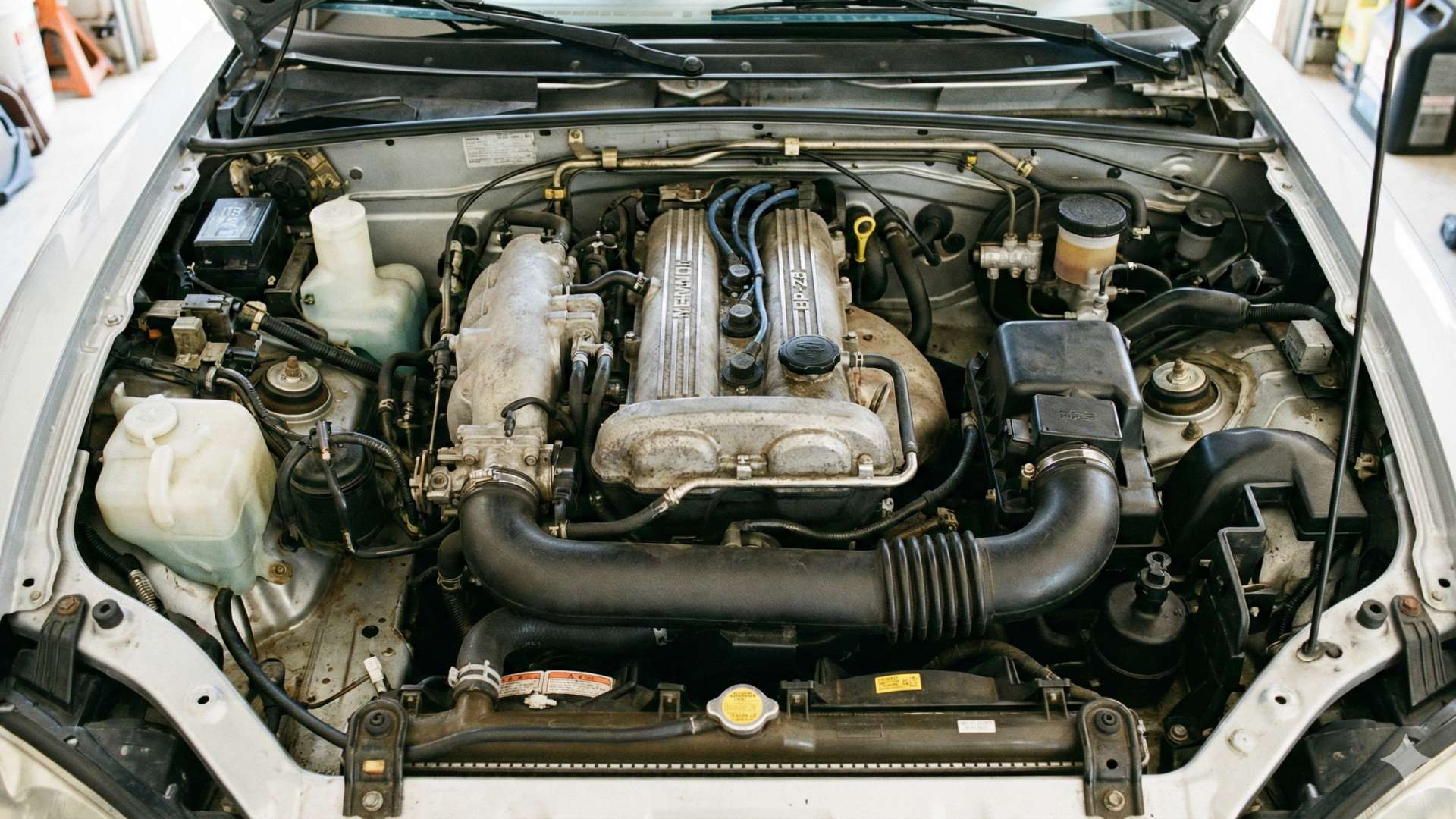
Pop the hood on any Miata and you find the same promise. A small four-cylinder, mounted low up front. It never shouts. It just revs. Under that calm surface sit four generations of engineering.
Yet “Miata engine” covers four very different motors. A 1990 car runs a 1.6-liter B6. A 2026 car runs a 2.0-liter Skyactiv-G. Parts, faults and upkeep change completely between them.
The stakes are real. A wrong guess means the wrong parts, a wasted weekend or a bad purchase. A belt that is optional on one car is a hard deadline on another. A plastic coolant tank can end an NC’s day. Knowing the engine first saves money at every step.
That is where buyers and owners get lost. Forum threads mix codes, years and horsepower figures. This guide sorts them out, generation by generation. You will know which engine you have. You will know what fails, and what to do next. Every figure comes from a source listed at the end.
In short: every US Miata uses a gas inline-four, never a rotary. The NA and NB run Mazda B-series engines of 1.6 and 1.8 liters. The NC uses a 2.0 MZR, the ND a 2.0 Skyactiv-G. Power ranges from 116 hp in 1990 to 181 hp since 2019. On belt-driven NA and NB engines, Miata.net recommends a new belt every 60,000 miles.
This page covers the Miata’s engines across all four generations. For choosing a whole car, see our complete Mazda Miata guide.
Last verified: October 2026
Before you pick an engine
Still deciding which generation fits your budget?
Our used Miata buying guide compares prices, best years and the checks that change from NA to ND.
What Engine Is in a Miata?
The constant under every hood
One layout, three engine families
Inline-four up front, twin cams, rear-wheel drive. Only the family behind it changes.
B-series
1.6 then 1.8 liters
B-series BP
1.8 liters, VVT from 2001
MZR
2.0 liters, chain drive
Skyactiv-G
2.0 liters in the US
Every Miata sold in the US has a naturally aspirated inline-four as standard. Twin overhead cams, four valves per cylinder, gasoline, rear-wheel drive. Only one factory exception breaks the pattern: the turbocharged Mazdaspeed of 2004 and 2005.
The family name changes with each generation. That matters, because parts catalogs and forums sort everything by engine family.
- NA (1990 to 1997): Mazda B-series, first the 1.6-liter B6, then the 1.8-liter BP.
- NB (1999 to 2005): B-series 1.8-liter BP, with variable valve timing from 2001.
- NC (2006 to 2015): 2.0-liter MZR, an all-new engine family.
- ND (2016 to today): 2.0-liter Skyactiv-G in the US market.
One myth deserves a quick burial. Mazda built rotary sports cars, so people assume a rotary Miata exists. It never left the factory. The Wankel only reaches a Miata through an aftermarket swap, covered further down.
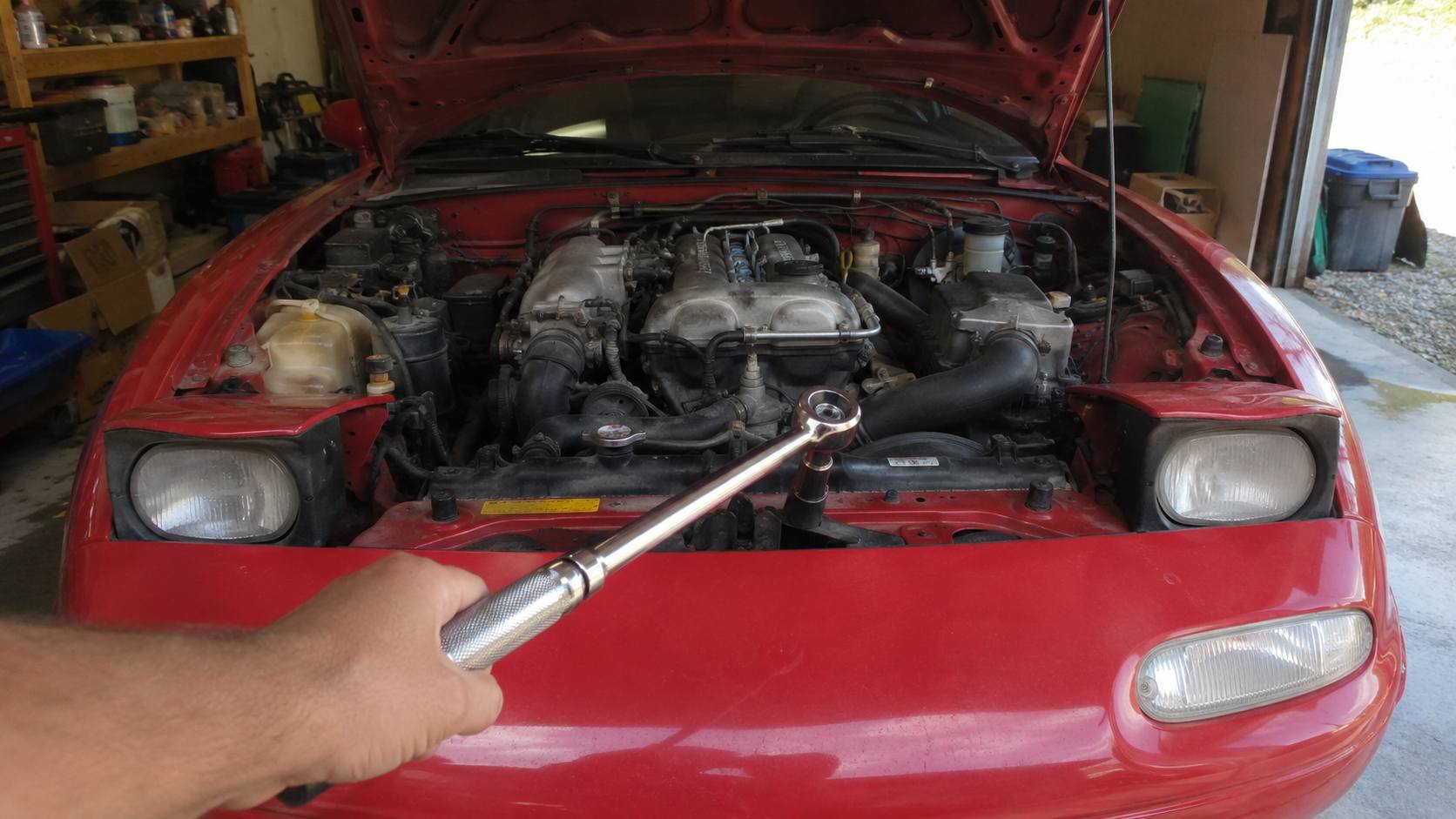
The Miata’s engines were never chosen for raw power. They were chosen for weight, balance and revs. Keep that in mind when you read the numbers below. They look modest because the car around them is light.
Miata Engine Specs by Generation: The Master Table
1990 NA 1.6, the starting point
ND from model year 2019, the current peak
gain from 1990 to 2019, same four-cylinder recipe
US-rated horsepower, engine by engine
Striped bar: factory turbo. Solid pink bar: current engine. NC automatic: 158 hp.
Here are the US-market engines, year by year. Figures come from the sources cited under the table. Where a reliable US figure was not found, the cell says so rather than guessing.
| Model years | Generation | Engine | Displacement | US power | Key note |
|---|---|---|---|---|---|
| 1990 to 1993 | NA | B6-ZE | 1.6 L (1,597 cc) | 116 hp | 100 lb-ft at 5,500 rpm, 7,000 rpm redline |
| 1994 to 1997 | NA | BP-ZE | 1.8 L (1,839 cc) | 128 hp at launch | Taller final drive than the 1.6 |
| 1999 to 2000 | NB | BP-4W | 1.8 L (1,839 cc) | 140 hp | 119 lb-ft, solid lifters |
| 2001 to 2005 | NB | BP-Z3 (VVT) | 1.8 L (1,839 cc) | 142 hp | Variable timing on the intake cam |
| 2004 to 2005 | NB Mazdaspeed | BP turbo | 1.8 L (1,839 cc) | 178 hp | 166 lb-ft, about 8.5 psi of boost |
| 2006 to 2015 | NC | MZR 2.0 | 2.0 L (1,999 cc) | 167 hp manual (2015 spec) | 158 hp automatic, 140 lb-ft, chain-driven cams |
| 2016 to 2018 | ND | Skyactiv-G 2.0 | 2.0 L | 155 hp | 148 lb-ft, 6,800 rpm redline |
| 2019 to 2026 | ND | Skyactiv-G 2.0 | 2.0 L | 181 hp | 151 lb-ft, 7,500 rpm redline |
factory turbocurrent engine
Sources: Car and Driver for the NA, Grassroots Motorsports for the NB2 and Mazdaspeed. Mazda USA's 2015 spec sheet covers the NC, Motor Authority the 2019 ND update. Current output comes from Mazda USA. B-series codes and displacements follow Wikipedia's Mazda B engine record.
How to read these numbers
The horsepower column tells only part of the story. A 1.6-liter NA makes its peak torque high, at 5,500 rpm. You drive it with the revs up, and it rewards you for it.

The 1.8 brought more torque. Torn between the two NA engines? Our NA Miata buyer's guide settles the choice with years, packages and prices.
The NB1 to NB2 switch is subtler. Two extra horsepower on paper, but the BP-Z3 adds variable valve timing on the intake cam. The NB2 Miata guide explains how to tell the two apart in thirty seconds.
Which Miata has 181 hp?
Every Miata from the 2019 model year onward. Mazda raised output on the ND without changing displacement. That is why ND buyers split the generation in two.
The 2019 update changed the ND's character more than any option box. Motor Authority (Mazda reveals updated MX-5 Miata with more power, features, 2018) gives the figures. Output rose from 155 to 181 hp. The redline climbed from 6,800 to 7,500 rpm. Mazda fitted new cylinder heads, pistons and connecting rods, with weight savings. Those 700 extra rpm are the change owners see on the tachometer.
For the full ND1 versus ND2 buying split, with prices and running costs, see our ND Miata buyer's guide.
Mazda USA lists the current 2.0 at 181 hp and 151 lb-ft, with a six-speed manual as standard. The 2026 Sport starts at $30,730 before destination, according to Mazda USA (checked October 2026).
Miata Engine Codes Decoded: B-Series, MZR and Skyactiv
Read the code, know the engine
Three families across four generations
Decoding a real code
Does the engine cross over?
bolts in with adaptingdifferent familysame generation
Based on Miata.net's NA and NB compatibility notes.
Engine codes look cryptic. They are actually the fastest way to know what you are buying, especially with used engines and parts listings.
B-series: the NA and NB engines
The B6 is the 1.6-liter. The BP is the 1.8-liter. Both share the same family design: an aluminum head and twin cams driven by a rubber belt.
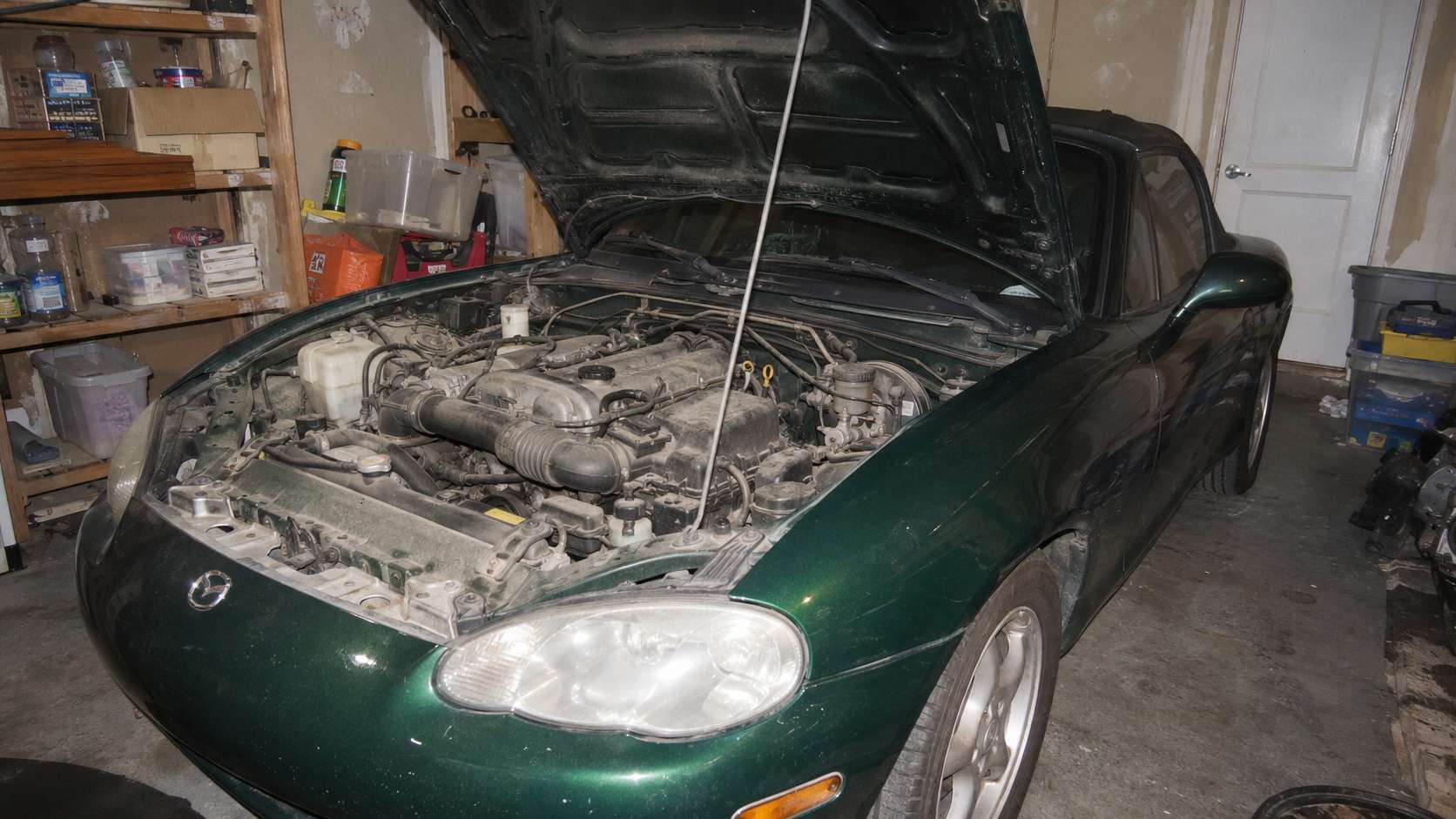
Suffixes mark the evolutions. BP-ZE is the NA 1.8. BP-4W is the 1999 to 2000 NB engine, with revised intake ports and solid lifters. BP-Z3 is the 2001 to 2005 version with variable valve timing.
Wikipedia's record of the Mazda B engine describes the family as a non-interference design. If the belt snaps, the valves and pistons should not collide. Car and Driver says the same for the NA. That is good news, but it is not a maintenance plan.
MZR: the NC engine
The NC broke completely with the past. Its 2.0-liter belongs to Mazda's MZR family, and Mazda's spec sheet lists chain-driven cams. Miata.net's compatibility notes put it bluntly: 2006 and later cars share little, if anything, with earlier Miatas.
That has a practical consequence. An NC engine is not a bolt-in for an NA or NB. Treat any listing that suggests otherwise with suspicion. Our NC Miata guide covers the generation's other strengths and weak spots.
Skyactiv-G: the ND engine
The ND uses Mazda's Skyactiv-G 2.0 in the US. Mazda USA lists no other engine for the current car, soft top or RF.
The ND engine exists in two states of tune, 155 hp and 181 hp. When you price a used ND engine, confirm its model year first. Only 2019 and later engines are the 181 hp version.
Do engines interchange between generations?
Within the NA and NB, often yes. Miata.net reports that a 2002 engine bolts to a 1994 transmission, starter and subframe with 2002 mount brackets. It also notes traps: an NA oil pan will not fit an NB engine because of baffle differences.
Across the NC and ND boundary, the engines come from different families. Treat any swap there as a custom project.
Textbook case: an NB1 owner finds a cheap 2003 engine and assumes a weekend swap. Mechanically, the block fits. The surprise comes from sensors, connectors and the variable timing control. The lesson is short: compatible metal is not compatible wiring.
How to Identify the Engine in the Miata in Front of You
Three checks, ten minutes
The car tells you its engine, if you ask the right places
Model year from the VIN
Match it to the spec table. 1993 means a 1.6, 1994 a 1.8, unless swapped.
Under-hood label
Compare the factory labels with the ad. Missing label plus wrong engine: red flag.
Cold start and scan
Hood open, listen, then read codes with an OBD-II scanner.
Year and engine disagree? Not proof of a scam. Proof you need receipts.
Sellers misquote engines more often than you would think. Engine swaps, mislabeled ads and copied spec sheets all add noise. Three quick checks clear it up.
Method 1: start from the model year
Federal rules (49 CFR 565.15) reserve the tenth character of the VIN for the model year. Match it to the master table above. A 1993 VIN means a 1.6, a 1994 means a 1.8, unless someone swapped it.
Then compare with what you see under the hood. A model year and an engine that disagree is not automatically a scam. It is a question that deserves receipts.
Method 2: read the labels under the hood
Look for the factory labels under the hood, including the emissions label, and compare them with the ad. A missing label plus a non-original engine is a red flag.
Our comparison of NA vs NB Miata lists the engines year by year, up to the NB's variable timing.
Method 3: let the engine talk
Ask for a cold start, with the hood open. Listen for ticking, knocking or a rattle at the front of the engine. Watch the exhaust for blue smoke at startup.
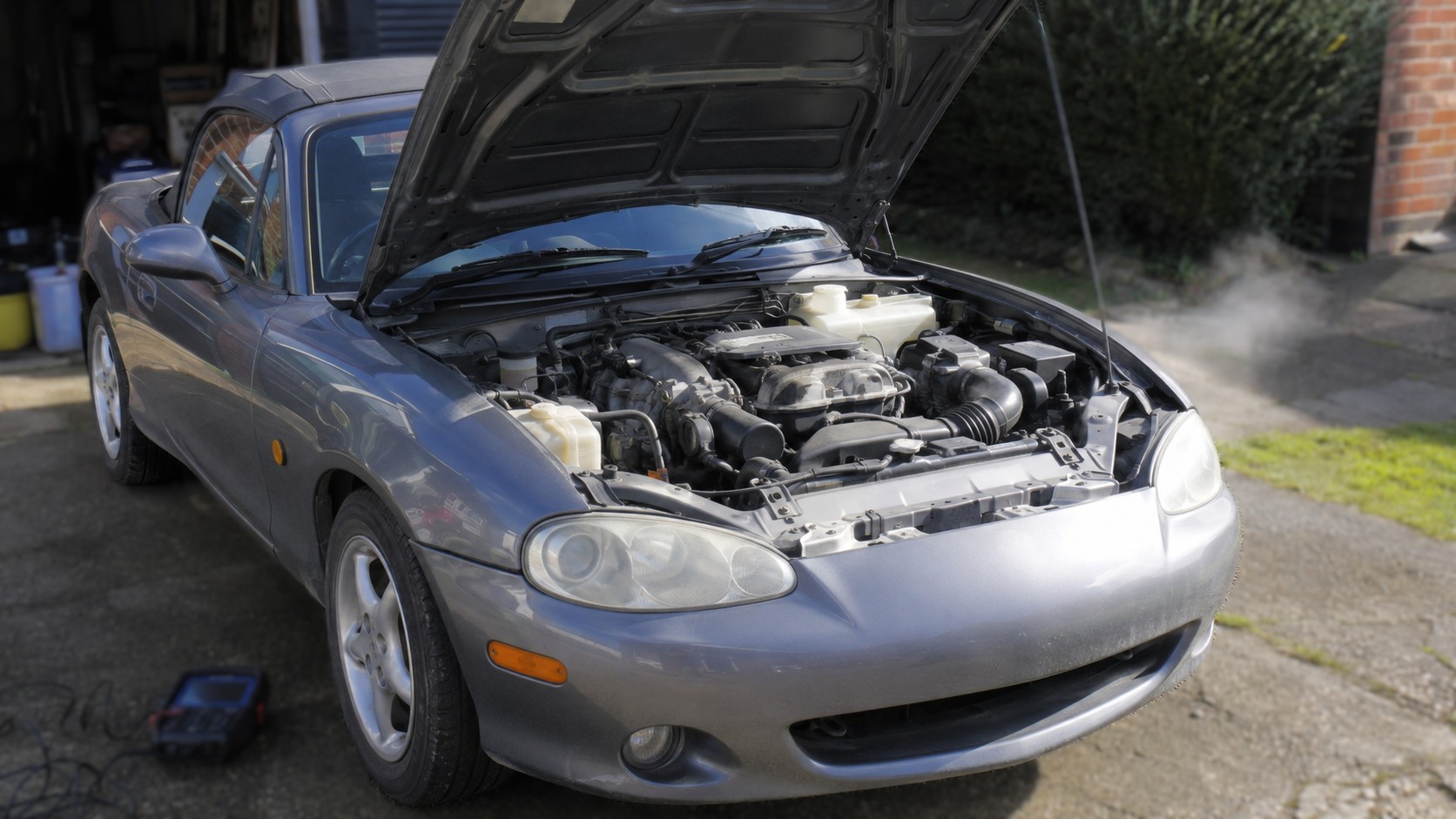
On cars with an OBD-II port, an OBD-II scanner reads stored and pending codes in seconds. A compression test settles arguments about a "healthy" high-mileage engine.
Miata Engine Reliability: The Real Weak Points by Generation
Where each engine is vulnerable
One known weak point per generation, and what to check
Short nose crank
Only 1990 and 1991 1.6 engines. A badly fitted crank bolt can wreck the engine.
Check: crank pulley wobble, who did the last belt job.
Mazdaspeed specifics
MAP solenoid hesitation and a weak fuel pump on the factory turbo.
Check: long test drive, scan for codes.
Coolant expansion tank
Aging plastic can crack, lose pressure and let the engine overheat.
Check: tank condition, coolant level, sweet smell.
Youngest engines, history first
None of the sources consulted documents a recurring engine failure on the US 2.0.
Check: oil changes on schedule, shop receipts.
Gauges: MX5Global editorial rating, not a statistic.
The Miata's engines have a strong reputation, and it is mostly earned. Car and Driver writes that an unmolested NA powertrain reaches 200,000 miles with simple maintenance. Weak points do exist, though. They are specific, and they are known.
NA: the short nose crank
The 1990 and 1991 1.6-liter engines have a smaller crankshaft nose. Car and Driver warns these engines can destroy themselves if the crank bolt is not installed correctly.
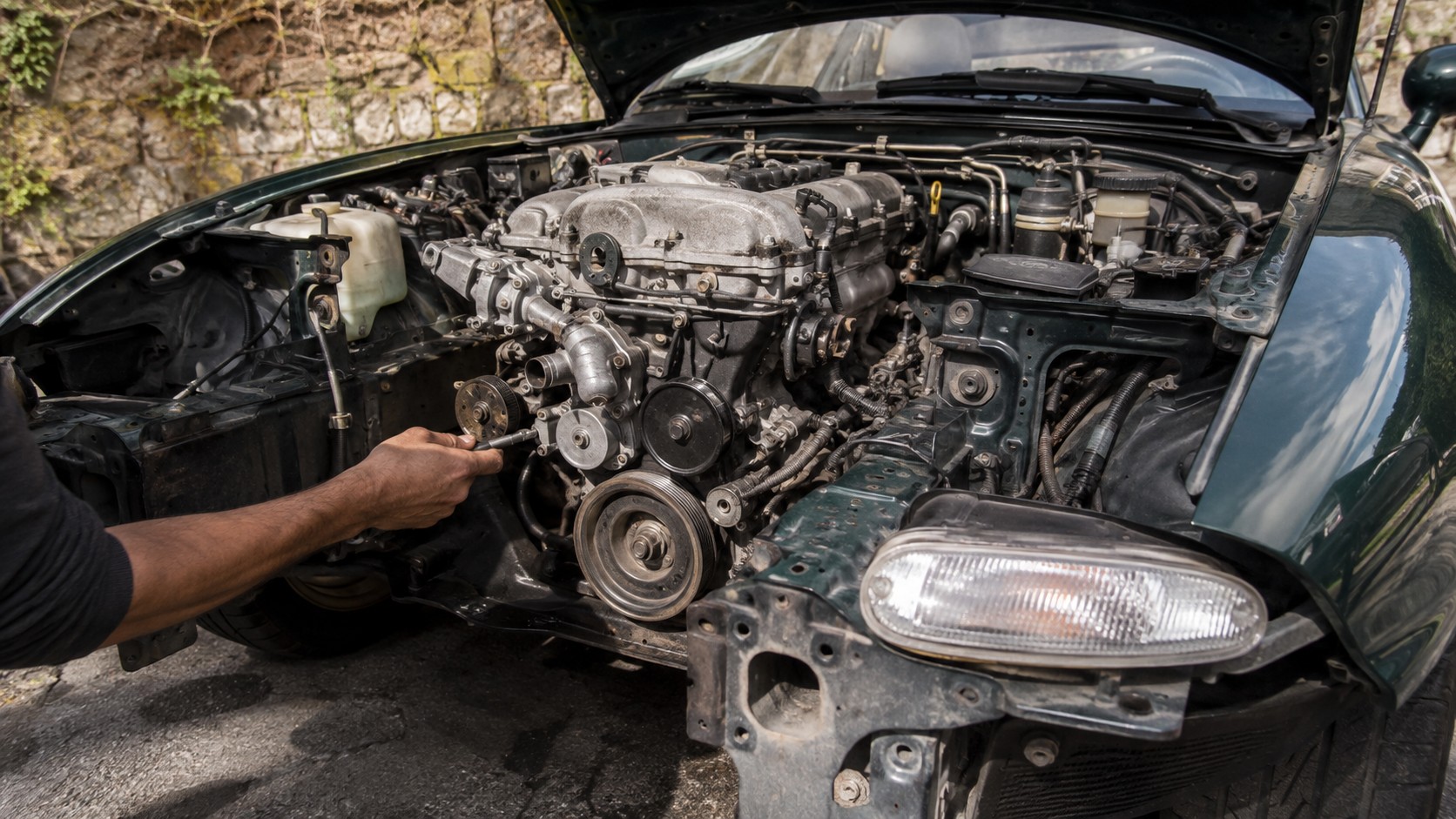
The crank bolt comes off during every timing belt job, as Miata.net's belt guide shows. That makes the belt job the moment of risk. It is the one NA engine issue worth checking before money changes hands.
Typical profile: a buyer finds a 1990 car with low miles and a "fresh timing belt". The first reflex is relief. The market reality is different: the belt job is exactly when the crank nose gets hurt. Ask who did it, and check the crank pulley for wobble.
NB: solid engines, a turbo with its own quirks
The naturally aspirated NB engines carry the BP's durable reputation forward. The Mazdaspeed turbo adds specific checks.
The Mazdaspeed is rare, which makes its known faults worth learning. Grassroots Motorsports (Buyer Guide: 2004-2005 Mazdaspeed MX-5 Miata, 2022) reports about 5,428 cars built over two model years, before a factory fire ended production. The same guide flags a failing MAP solenoid that causes hesitation and a weak fuel pump. With so few cars, a neglected one costs more to fix than to avoid.
NC: watch the cooling system
The NC weak point Flyin' Miata flags sits next to the engine. It is the plastic coolant expansion tank. Flyin' Miata says it has seen engines damaged by cracked stock tanks, which lose pressure and let the engine overheat.
Classic scenario: an NC owner notices a faint sweet smell after drives, then ignores it. The reflex is to top up coolant and move on. The tank is aging plastic under pressure and heat. The lesson: on an NC, an old expansion tank is a wear part, not a lifetime part.
ND: young engines, few patterns
The ND engines are the youngest of the four. None of the sources consulted for this guide document a recurring engine failure on the US 2.0. That is reassuring, not a guarantee.
Service history matters more here than mileage. Look for oil changes on schedule and receipts from a shop that knows the car.
Shopping a 1999 to 2005 car?
Our NB Miata for sale guide covers the inspection, the VIN checks and the questions that expose a tired engine.
Miata Engine Maintenance: What Actually Keeps It Alive
Belt or chain decides the calendar
Two cam drives, two maintenance logics
NA and NB: rubber timing belt
Miata.net recommends a new belt every 60,000 miles. If the water pump is due, do it then.
NC: timing chain, no belt interval
Mazda lists chain-driven cams on the MZR 2.0. Its health depends on what you do between services.
Every generation: hoses, radiators and plastic parts age with heat cycles, not only with miles.
Miata engines forgive a lot. They do not forgive skipped basics. Two items deserve most of your attention: the cam drive and the cooling system.
Timing belt cars: NA and NB
Owners argue about the belt interval because the California manual lists a longer figure. According to Miata.net (Timing Belt Replacement, Gary Fischman), the belt should be changed every 60,000 miles. The author notes the 105,000-mile figure reflects a state requirement, not his recommendation. If you plan to replace the water pump, the belt job is the time to do it.
A non-interference engine makes a snapped belt less catastrophic. It still leaves you stranded, on a tow truck, with a bill. On the earliest NA engines, a sloppy belt job can also hurt the short nose crank.
Chain-driven NC, schedule-driven ND
Mazda's spec sheet lists chain-driven cams on the NC, so there is no timing belt to schedule. Keep oil changes on time. Rattles at cold start deserve attention.
For the ND, follow Mazda's maintenance schedule for your model year. Keep every receipt.
Cooling and oil, every generation
Every Miata engine runs in a tight bay. Hoses, radiators and plastic parts age with heat cycles, not just miles. A twenty-year-old car with low mileage still carries twenty-year-old rubber.
Check oil level between changes, especially on older engines driven hard. A Miata revs high by design. Low oil and high revs make a poor combination.

MX5Global's take, as an editorial opinion: the cheapest Miata engine is the one with boring receipts. A shiny engine bay proves a pressure washer exists. Paperwork proves the work was done.
Replacing a Tired Miata Engine: Rebuild, Used Engine or Swap
One tired engine, three exits
Pick the path that matches your car and your calendar
Rebuild the original
Fits: collector cars, Mazdaspeed, documented originals.
Used engine, same family
Fits: most NA and NB owners who want to drive again soon.
Swap another engine
Fits: project builders with time, a shop and a state that allows it.
Dots: MX5Global editorial rating, not a statistic.
Sooner or later, an old Miata engine runs out of compression or patience. Three paths open up. Each suits a different owner and budget.
Rebuild the original
Rebuilding keeps the numbers-matching engine and its known history. It suits collectors, original cars and rare versions like the Mazdaspeed. It also takes the longest and depends on a machinist you trust.
Fit a used engine from the same family
On NA and NB cars, this route keeps you inside one engine family. Used B6 and BP engines turn up regularly in salvage listings. Within the family, the Miata.net compatibility notes above show what bolts in and what needs adapting.
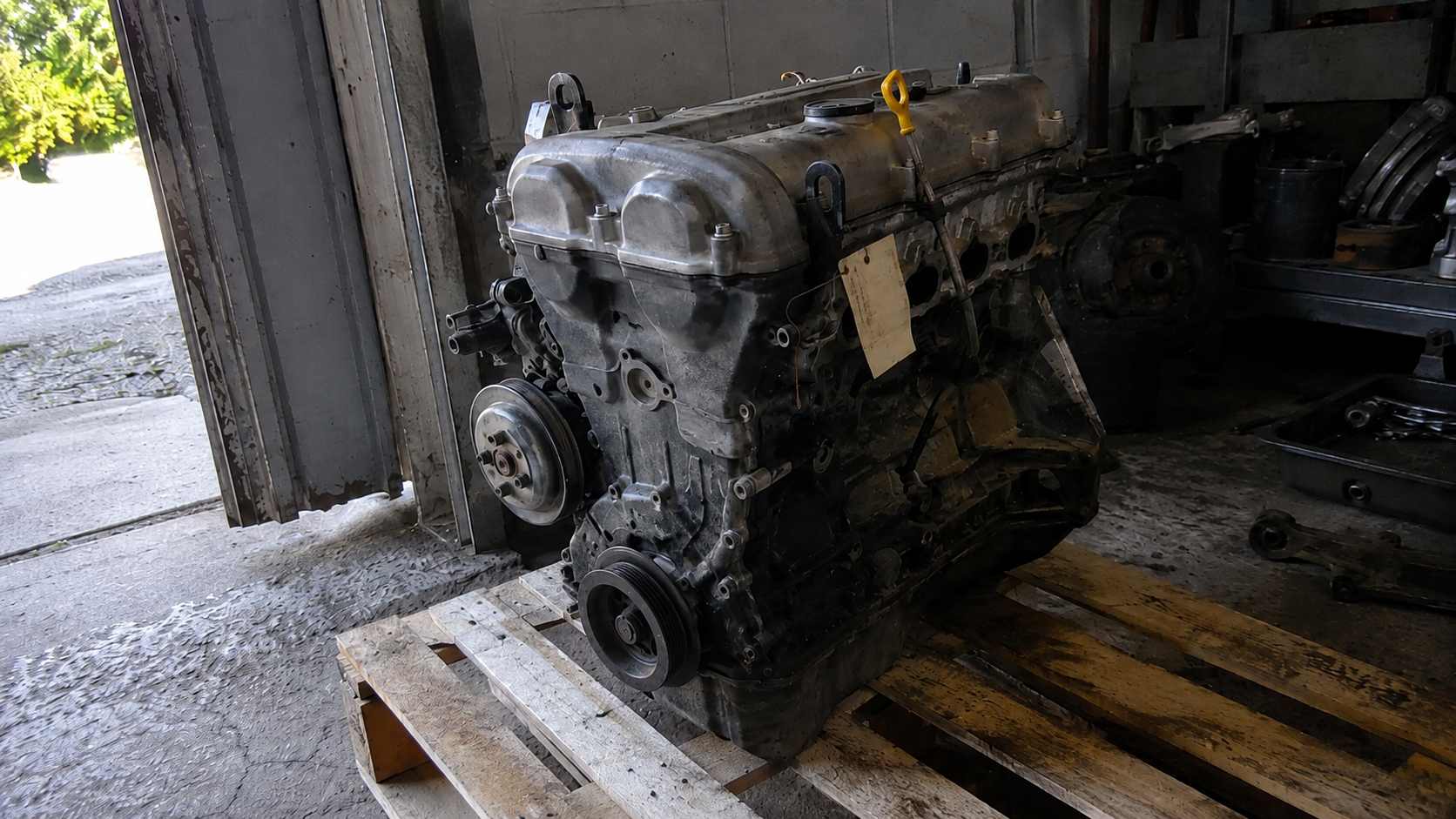
Read listings closely. Salvage sellers often flag damaged long blocks in the title itself. Ask for the mileage source, a compression test and a return policy before you pay.
Swap in another engine entirely
Swaps are a separate world. A non-Mazda engine turns a maintenance job into a project car.
Mounts, cooling, driveline, wiring and tuning all change. Emissions legality also depends on your state, so check with your state's emissions program before buying parts.
Case in point: an owner with a blown 1.6 prices a V8 swap "for the same money". The reflex is to compare engine prices only. The real budget includes the driveline, cooling and months off the road. Replacing like for like gets the car back first.
Three Miata Engine Mistakes That Cost Real Money
Avoidable, every one of them
The three engine bills you can see coming
"Rebuilt" with no invoices
The word covers anything from a machine-shop job to fresh gaskets and paint.
Fix: no invoice, price it as unrebuilt.
Delaying the belt
Non-interference limits damage, not downtime.
Fix: follow the 60,000-mile rhythm.
Power before health
Boost multiplies an engine's weaknesses.
Fix: compression, cooling and leaks first.
Each of these mistakes costs more than the check that prevents it.
Mistake 1: trusting "rebuilt" without paperwork
"Rebuilt" can mean a full machine-shop job or new gaskets and a coat of paint. Without invoices, assume the cheaper version. Price the car accordingly.
Mistake 2: delaying the belt because "it's non-interference"
The non-interference design limits the damage of a snapped belt. It does not make the belt last forever. A belt that fails on a highway still means a tow and a lost day. On early NAs, it can also mean a damaged crank nose.
Mistake 3: buying power before health
Turbo kits and swaps tempt every Miata owner. Bolting boost onto a tired engine multiplies its weaknesses.
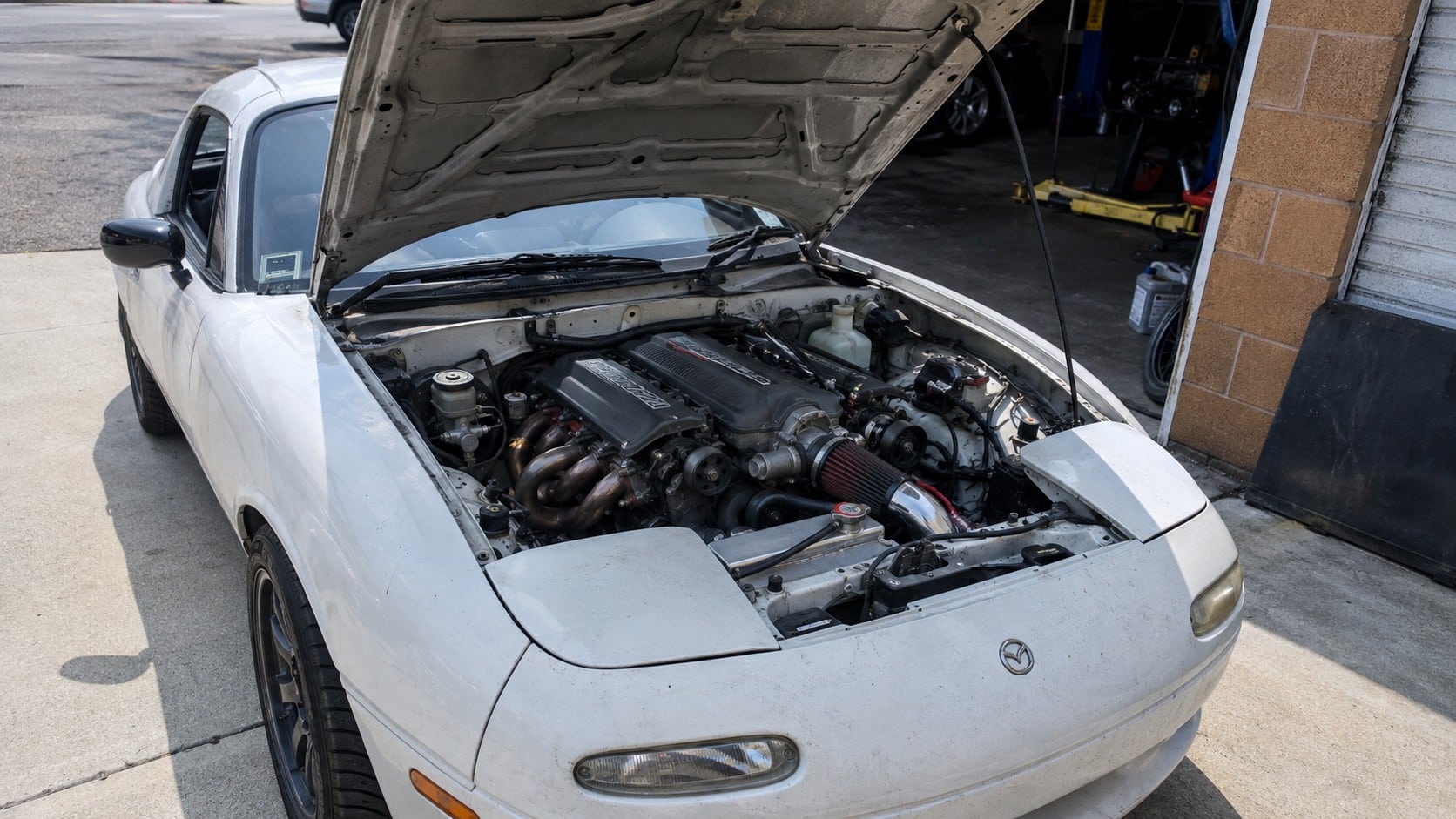
Fix compression, cooling and leaks first. Then decide whether you still want more power.
What Engine Will the Next Miata Get? (Forecast)
From the B6 to the Skyactiv-Z
Displacement keeps growing, the formula stays light
Today's Skyactiv-G against the Skyactiv-Z expected in the NE. An electric version is also being prepared.
Forecast based on Mazda statements reported by Carscoops, July 2026. Not a confirmed spec.
Mazda has not released the next-generation Miata, known as the NE.
Everything below is reported intent, not a confirmed spec.
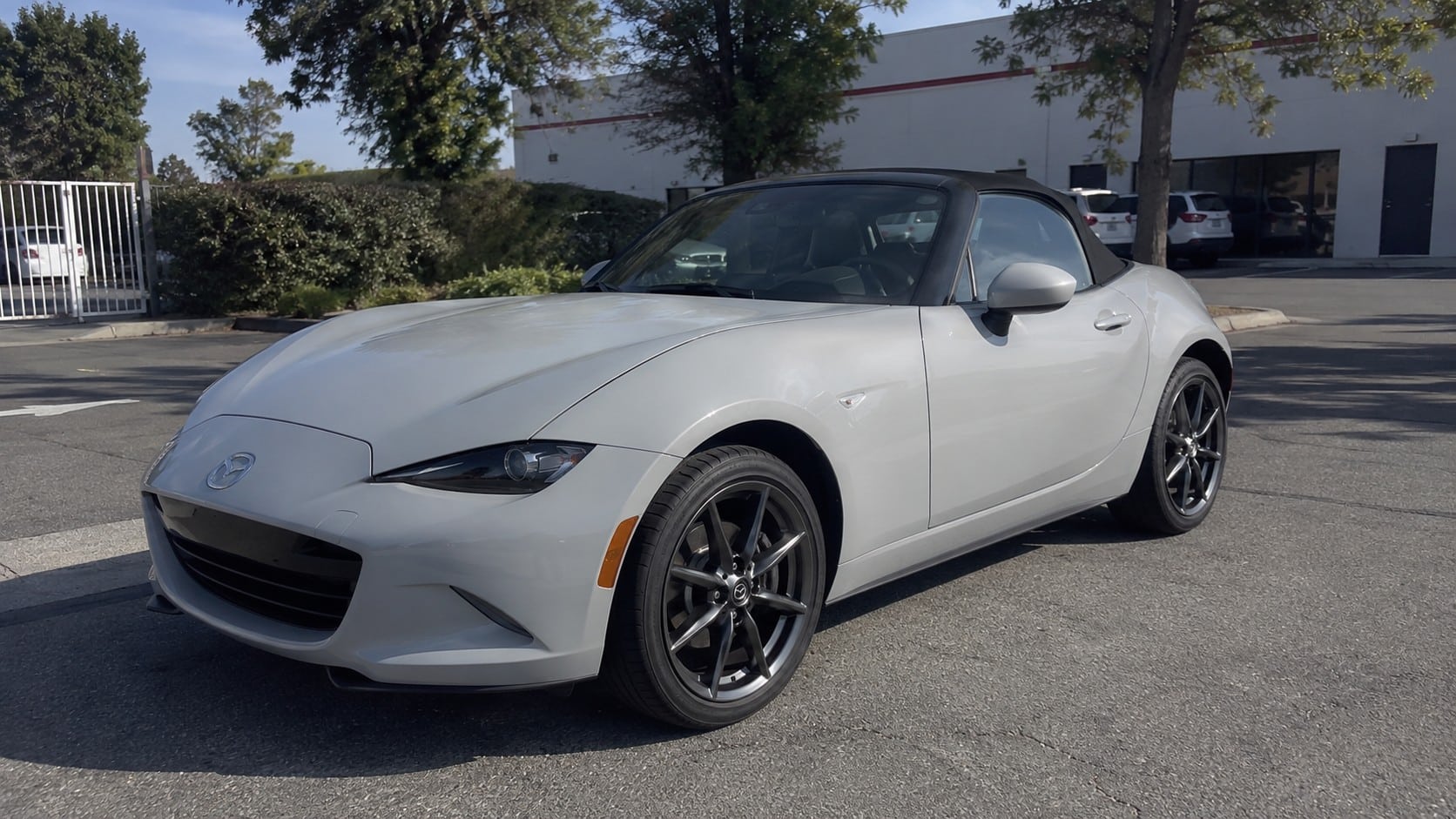
The next Miata engine is the one question every current owner asks. Carscoops reported in July 2026 (Mazda's CEO Confirms Next MX-5 Goes Electric And Gas) on the plan. The NE is expected to use Mazda's new 2.5-liter Skyactiv-Z four-cylinder. The car is also being prepared for an electric version, and is not expected before 2028. For today's buyers, that means the 2.0 Skyactiv-G stays the newest engine you can actually own.
Pick the Engine That Matches Your Miles, Then the Car
The MX5Global verdict
Buy the engine's history, then its horsepower
NA 1.6
Rewards revs and patience. Check the crank nose.
NB2 1.8 VVT
The most rounded B-series, belt included.
NC 2.0
No belt to plan. Watch the cooling system.
ND 2019+
181 hp and a 7,500 rpm top end.
Whatever the pick: receipts first, horsepower second.MX5Global editorial opinion
Every Miata engine can deliver the experience the car promises. The right one depends on how you drive and how much maintenance you want to own.
A 1.6 NA rewards revs and patience. In our view, a late NB with variable timing is the most rounded B-series. The NC trades belt worries for cooling vigilance. The ND gives you the newest engine and, since 2019, a real top end.

Whatever you choose, buy the engine's history before its horsepower. Want hands-on advice from owners near you? A local club tech day puts you next to owners who have done the job before. Our Miata club guide shows how to find one and join.
Your Most Common Questions About the Miata Engine
Did Mazda ever sell a rotary Miata?
No. Every production Miata uses a piston inline-four engine, including the turbocharged Mazdaspeed. A rotary Miata is always an aftermarket swap, never a factory car. Those cars can be impressive, but they are custom builds with custom problems. Value them as one-off projects, not as rare factory versions, and expect specialist maintenance.
How many miles can a Miata engine last?
Mileage alone tells you little. Belt history, oil records and a compression test tell you more than the odometer. What shortens Miata engine life is neglect: missed belts, low oil, overheating. In our view, a documented 150,000-mile engine is often a safer bet than an undocumented 70,000-mile one. Ask for those papers before you talk price.
Does the Miata RF have a different engine?
Not in the US. The RF is a body style of the ND, and it shares the Skyactiv-G 2.0 with the soft-top. Mazda USA lists the same 181 hp for the 2026 RF. ND1 RFs carry the 155 hp tune, 2019 and later RFs the 181 hp one. Our Miata RF buyer's guide covers the roof-specific checks.
Can a stock Miata engine handle a turbo?
The factory proved the B-series can take moderate boost, since the Mazdaspeed ran about 8.5 psi from the dealer. A healthy engine is the precondition, not the turbo kit. Fuel delivery, engine management and cooling must be sized for the boost. A worn engine with boost bolted on fails faster, and usually more expensively, than it would have stock.
Is a 1.8 Miata engine faster than the 1.6?
Yes, but not by as much as the badge suggests. Car and Driver says the 1.8 NA is about half a second quicker to 60 mph. The 1.6 feels a little smoother. The 1.6 vs 1.8 choice is really about character, budget and the early short nose crank. Condition and history should still decide before displacement does.
Which Miata engine is the easiest to work on?
In our view, the B-series in the NA and NB. Its simple layout and decades of owner guides make it the easiest Miata engine for home mechanics. Miata.net's garage pages are a good start. Later generations reward the same care. Check that you have the right diagnostic tools before you start a job.
Sources
- Mazda USA, 2026 MX-5 Miata engine, trims and pricing
- Mazda USA, 2026 MX-5 Miata RF engine
- Mazda USA, MX-5 Miata specifications sheet (NC)
- Car and Driver, What to Buy: 1990-97 Mazda MX-5 Miata
- Grassroots Motorsports, Mazdaspeed MX-5 Miata buyer guide
- Motor Authority, ND Miata power update
- Miata.net, Timing belt replacement guide
- Miata.net, NA and NB parts compatibility
- Flyin' Miata, NC coolant expansion tank
- Wikipedia, Mazda B engine family
- eCFR, 49 CFR 565.15, VIN content requirements
- Carscoops, Next MX-5 powertrain plans

Alan Chevereau, founder of MX5Global and Mazda MX-5 owner. MX5Global is an independent site dedicated to the Mazda MX-5 Miata, online since November 2025. Every guide is built from verified sources, current market prices and published owner reports.