

Published on :
Updated on :
NA Miata, the honest picture
Same model year, same engine. Three completely different cars.
After 35+ years, where an NA lived tells you more than its spec sheet. Read the history first, the options later.
Rust Belt daily
Salt, snow, clogged drains
Typically hides rot in the rockers ahead of the rear wheels. Often invisible under fresh paint.
Sun Belt garage car
Solid metal, tired cabin
Rust is rare, but expect a cracked dash, brittle top and baked rubber seals.
Track-day toy
Fun history, unknown parts
Worn bushings, cheap coilovers and past mods. Receipts decide what it is worth.
You have seen one at a Cars and Coffee. Pop-up headlights, a tiny steering wheel, a driver grinning at idle. Then you open the listings and the dream gets messy.
One NA Miata costs next to nothing and hides rotten rockers. Another costs a small fortune, and nobody explains why. The first Mazda MX-5 Miata is now more than 35 years old. Every car has lived a different life, in a different climate, with different owners.
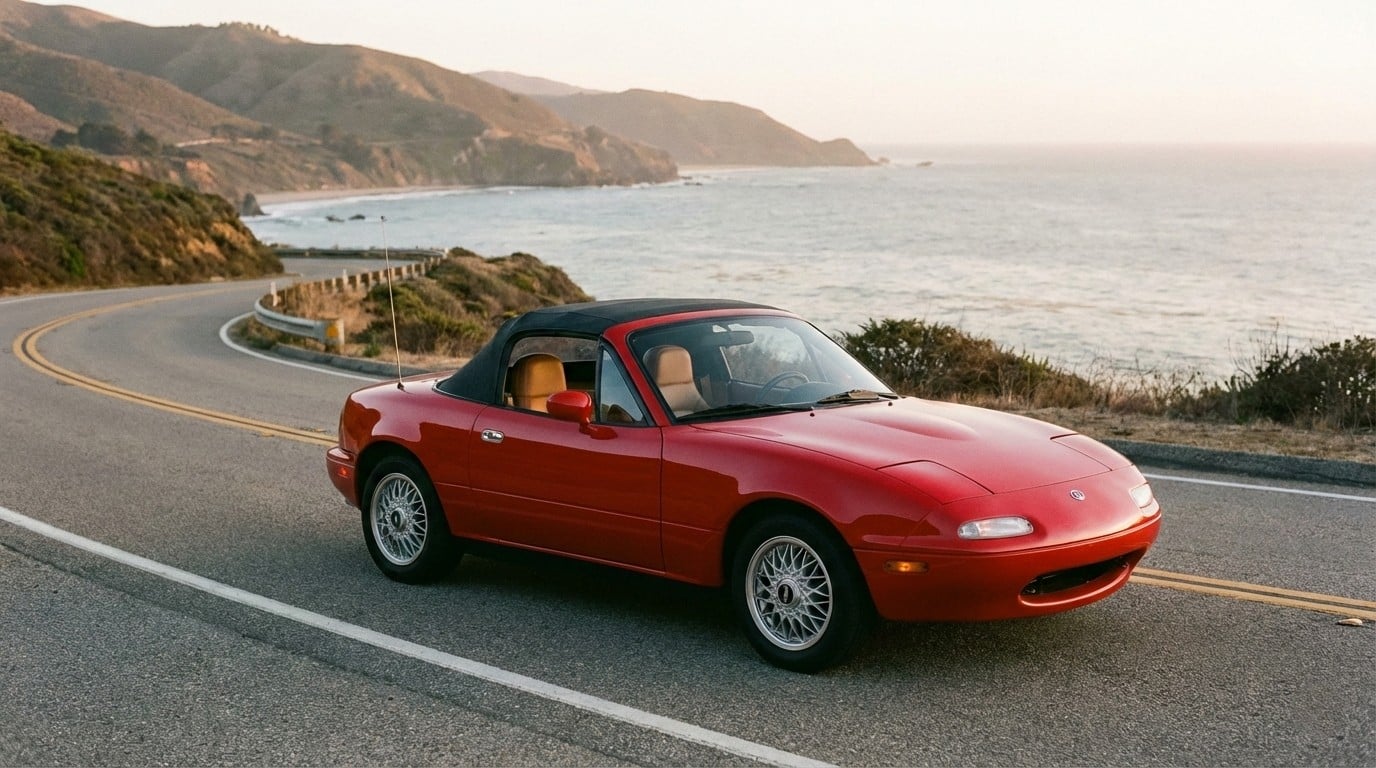
That is the real problem. Year, engine and options matter. The body underneath matters more. This page gives you the eyes of a picky buyer. Which cars to chase, which flaws are cheap, which ones end it. Read it once, and you will know where to look first on any first-gen Miata. And knowing when to walk away.
Already looking at a specific car? Run its model year and VIN through our NA decoder before you call the seller.
Open the NA decoderWhat makes the first gen Miata worth chasing in 2026
Built worldwide, 1989 to 1997
431,506
first-generation cars. That volume is why parts, clubs and specialists still keep NAs on the road.
1990 base MSRP, less than half the price of that year’s Corvette. Cheap to buy meant driven hard, raced and modified.
The NA was born in Southern California, not Hiroshima. A small Mazda team there pushed a front-engine, rear-drive roadster prototype over rival concepts. The brief was simple: bring back the British sports car, then make it start every morning.
It worked. The car debuted at the 1989 Chicago Auto Show and went on sale as a 1990 model. Mazda built 431,506 NA cars worldwide before the NB took over. That figure comes from the production history of the first-generation MX-5. That volume is why parts, forums and specialists still exist today.
Part of the legend is how little it asked of its first buyers. According to Hagerty (The Base Price of Every Miata, Adjusted for Inflation, 2025), the 1990 Miata listed at $13,800. That was less than half the price of that year’s Corvette. That accessibility is exactly why so many NAs were driven hard, raced, modified and neglected.
What you get is refreshingly analog. Think a curb weight around 2,200 lb and double wishbones at all four corners. Add near 50/50 balance and unassisted steering on base cars. No screens, no drive modes, no stability control. The car talks through the wheel and the seat, and it never stops talking.

What you do not get matters just as much. The NA is not fast by modern standards. A base Honda Civic will pull away from it on the highway. The body flexes over broken pavement, especially on early cars without the later bracing. The cabin is tight, loud and drafty with the top up.
This one comes up regularly in the messages MX5Global receives. A reader writes in convinced the NA is too old to be reliable. Then they drive a clean, original one. Three corners later, they understand why this car revived the whole lightweight roadster category on its own.
NA6 vs NA8: which NA Miata engine is right for you?
116 hp vs 133 hp
Same shape, same pop-ups, two personalities.
NA6
1.6 liter, 1990 to 1993
- Feel: lightest cars, rev-happy, the purist pick
- Watch: short nose crank on 1990 and early 1991 cars
- LSD: viscous unit, optional
NA8
1.8 liter, 1994 to 1997
- Feel: stronger midrange, calmer on the highway
- Hardware: bigger brakes, extra bracing, 4.30 final drive
- LSD: Torsen unit on LSD cars, R Package available
Engine is the tie-breaker. The rockers decide first.
Enthusiasts split the generation in two. NA6 means the 1.6-liter cars from 1990 to 1993. NA8 means the 1.8-liter cars from 1994 to 1997. Same shape, same pop-ups, two distinct personalities.
The 1.6-liter NA6: light, eager, a little fragile at the front
The US-spec 1.6 makes 116 hp and 100 lb-ft of torque. It loves revs and sounds happiest near the top of the tach. It also sits in the lightest cars of the generation, so the whole car feels nervous in a good way.
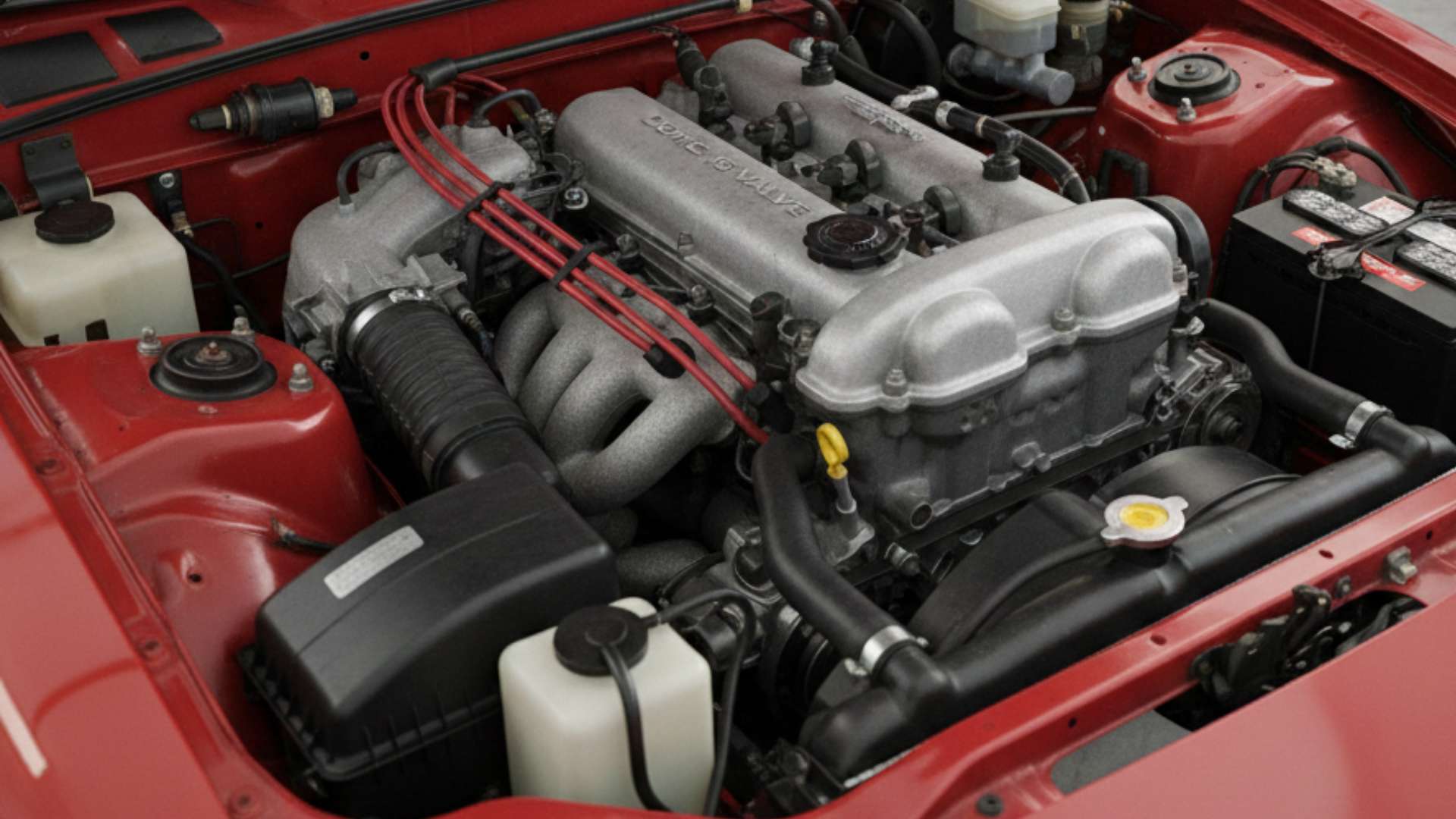
The catch lives at the nose of the crankshaft on 1990 and early 1991 engines. We cover that issue in the reliability section, because it changes how you inspect the car. It is manageable, but it is not a detail.
The 1.8-liter NA8: more torque, more brakes, more car
The 1.8 arrived for 1994 with roughly 128 to 130 hp depending on the source, then 133 hp from 1996. More useful is the extra midrange. The car pulls cleaner out of tight corners and on highway on-ramps.
Mazda did not just swap engines. The 1994 update added chassis stiffening, bigger brakes and a shorter 4.30 final drive. That detail comes from Summit Racing’s year-by-year NA buyer’s guide. Limited-slip cars also switched to a Torsen unit that year. The trade-off is a slightly heavier, calmer car.
So which one should you buy?
Buy the best body you can find, then let the engine break the tie. Here is how the decision usually lands:
- Back roads and pure feel: a clean NA6. It is the most direct version of the idea, and the one purists chase.
- Mixed use and highway miles: an NA8. The torque makes daily traffic less of a chore.
- Autocross or track days: an NA8 with the factory limited-slip. Better brakes and the Torsen unit give you a stronger base.
- Tight budget: whichever car has the best rockers and records. A sound 1.6 beats a tired 1.8 every time.
NA Miata specs and year-by-year changes
Interactive tool
Decode an NA Miata before you drive across the state
Pick the model year from the title. For 1990 or 1991 cars, add the last six digits of the VIN.
Based on documented factory changes. Options varied by car, so always confirm on the vehicle and its paperwork.
Mazda kept the shape almost untouched for eight model years. The changes happened underneath, and a few of them move the price. Here is what actually matters when you read a listing.
1990 and 1991: the originals, and the VIN that matters
Early cars came with the 1.6, a five-speed and option packages labeled A, B and C. The A package brought power steering and alloys. The B package added power windows and cruise control, and C combined both.
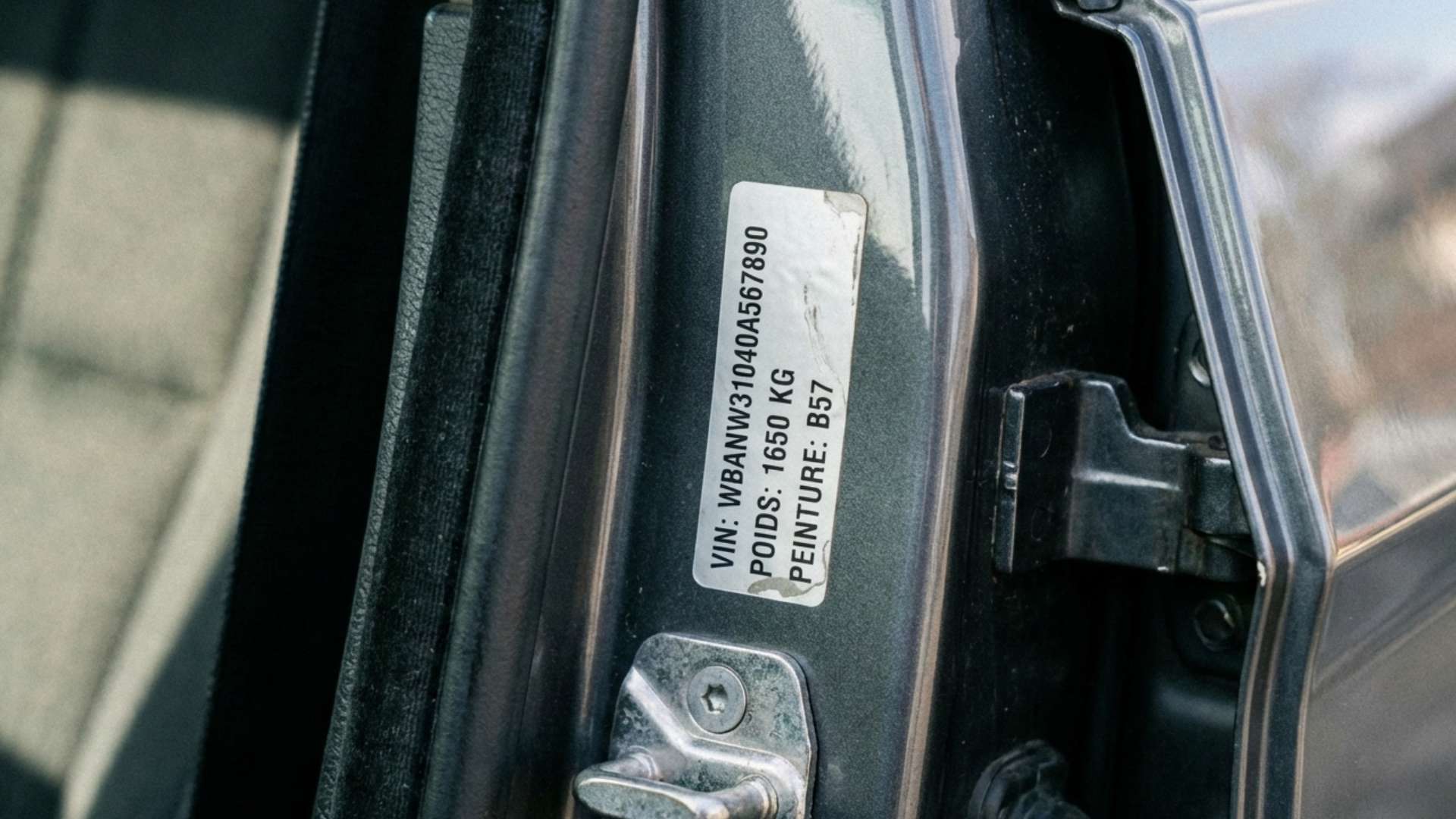
For 1991, Mazda added an optional four-speed automatic and made antilock brakes available with the B package. A viscous limited-slip was on the options list. Most importantly, Mazda revised the crankshaft nose partway through the model year.
The cutoff is on the VIN. Cars numbered 209446 or lower carry the smaller “short nose” crank. The Miata.net technical write-up on NA crankshafts documents that split. Anything from 209447 up has the stronger design.
1992 and 1993: quiet refinement
For 1992, a rear suspension brace joined the car. It was also the only year of Sunburst Yellow, the loudest factory color of the generation. The 1993 model changed little. Its Limited Edition, with black paint and red leather, is now a collector favorite.
1994 and 1995: the 1.8 era begins
This is the big split. The 1.8, the bigger brakes and the extra bracing all arrived for 1994. So did the R Package, Mazda’s factory performance group, which stayed available through 1997.
For 1995, Mazda simplified the options sheet. The A, B and C packages gave way to a Popular Equipment Package, with a Leather Package stacked on top.
1996 and 1997: OBD-II and the finale
The 1996 model gained OBD-II diagnostics and the 133 hp rating. That port is a real advantage today, because any cheap scan tool can read it. The 1997 model closed the generation with reshuffled option bundles and a handful of special editions.
Packages and special editions: which ones add real value
The NA value ladder
Each step adds a story. None of them lifts a car off a rotten floor.
Before paying a premium
A special edition is not automatically a better car. It is a car with a story, and the story only pays if the paperwork backs it up. Condition still sets the floor.
The R Package, the enthusiast’s pick
Offered from 1994 to 1997, the R Package bundled Bilstein shocks and retuned springs. It added bigger alloys, sportier tires and some aero pieces. Summit Racing’s guide calls it the best-performing NA straight from the factory. It was meant for people who drive, so many were driven hard. Check the shocks and bushings before you pay the premium.
Launch-era and collector editions
The 1991 British Racing Green special edition leaned into the car’s British roots with tan leather. The 1993 Limited Edition went the other way, with black paint and a red interior. At least one longtime member of the Grassroots Motorsports forum prefers the LE as a collectible.

Later years brought the M Edition trims and, for 1997, the STO in Twilight Blue Mica. These are desirable, but they are still NAs. They rust in the same places.
Does paint color change the price?
Less than you think. Hagerty analyzed several years of NA and NB auction sales and found no consistent premium for rare or specific shades. Its advice matches ours: buy the color you love, then pay for condition.
NA Miata reliability and rust: what actually goes wrong
Where NA money disappears
Water finds the rockers from above. The crank fails from the front. Everything else is a negotiation.
Walk away
- Crusty, flaky inner rocker seams
- Visible wobble at a 4-slot crank pulley
- Filler hiding rot on the rear fender lips
Negotiate
- Brown radiator tanks
- Leaky or torn top
- No-name coilovers, undocumented mods
Live with it
- Minor electrical quirks
- Faded interior plastics
- Soft, tired bushings
The NA’s reputation for reliability is earned. The engines tolerate high mileage when fluids and belts are done on time. What kills these cars today is age, water and bad past repairs. Here is where to focus.
The short nose crank on 1990 and early 1991 cars
On early 1.6 engines, the crankshaft nose and its key are not tolerant of assembly mistakes. Under-torque or over-torque the pulley bolt, or reuse a worn key, and the keyway can wallow out. Worst case, the nose breaks and the engine has to come out.
You can identify the crank in seconds. Flyin’ Miata explains the trick. Four slots in the crank pulley face mean a short nose, eight slots mean a big nose. With the engine running, any visible wobble at that pulley is a hard stop.
A pattern shows up again and again on Miata forums. A 1990 car gets a cheap timing belt job. A few hundred miles later, the owner notices the pulley wobbling and the engine running rough. The lesson is short: on these cars, who did the belt matters as much as when.
Rust: rockers, rear fender lips and clogged drains
Rust is the number one reason NAs leave the road. The classic spot is the rocker panel just ahead of each rear wheel, where it meets the quarter panel. Water enters through the soft top’s rain rail drains. When those tubes clog, water stays trapped inside the sill.
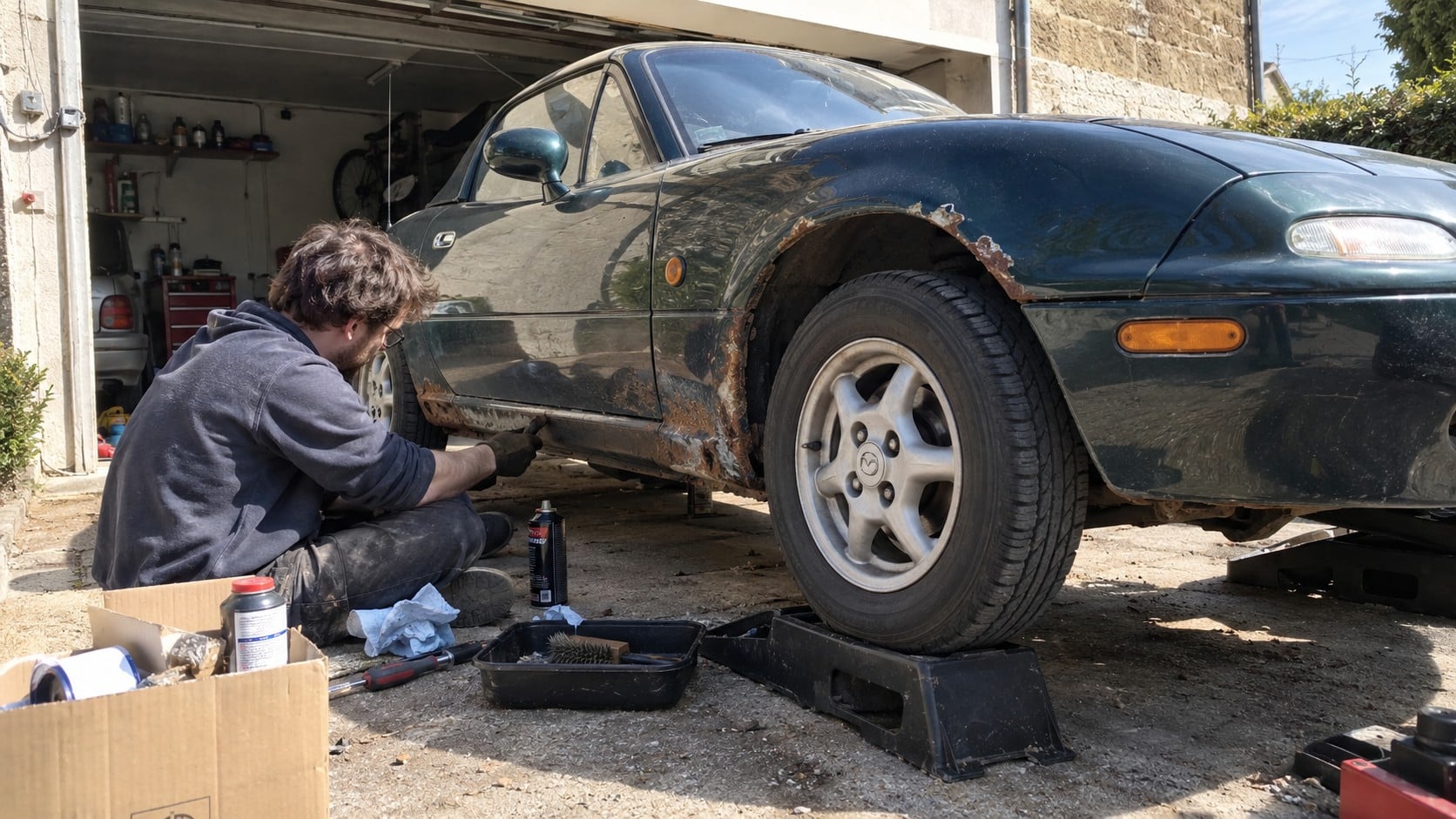
Owners on Grassroots Motorsports describe the telltale symptom: water audibly sloshing inside the rocker. Mazda sealed those sills so well that trapped water has nowhere to go. It rusts the panel from the inside while the paint still looks fine.
The Rust Belt multiplies all of this. Cars that saw salted winter roads in states like Michigan, Ohio or Pennsylvania deserve a much harder look. Sun Belt cars trade rust for other problems, like cracked dashboards and a brittle top.
Three checks take ten minutes and filter out most bad cars:
- Raking light: hold a flashlight almost flat against the rockers and rear fenders. Filler, bubbles and waves jump out.
- Drain test: pour a little water in the rain rail behind the seats. It should exit quickly in front of the rear wheels.
- Underside touch: run a gloved hand along the inner rocker seams. Crusty, flaky metal means the rot is already structural.
Cooling, top and the smaller stuff
Hagerty’s generation-by-generation Miata guide flags a simple tell: if the radiator‘s plastic tanks have turned brown, replace the radiator. Also inspect the top’s fabric, seams and rear window. A worn top leaks, and leaks feed the rust above.
Expect some age-related electrical quirks, faded interior plastics and soft bushings. None of these should scare you off a sound car. They are negotiating points, not deal breakers.
Past modifications, the hidden variable
For years the NA was a cheap car, and cheap cars get cheap parts. No-name coilovers, hacked wiring and mystery exhausts are common. Modifications are not a problem in themselves. Undocumented modifications are.
How much is an NA Miata worth in 2026?
NA Miata values, Hagerty 2026
$8,000 to $42,525
From a good early driver to the auction record for a stock car.
Condition moves the price far more than model year. Source: Hagerty, 2026.
The days of the throwaway Miata are over. Clean, original cars have climbed into collector territory, while tired cars still trade cheaply. The gap between the two keeps widening.
Values now depend heavily on year and condition. According to Hagerty (Does Your Miata’s Color Make It Worth More?, 2026), early 1.6-liter NAs in #3 “good” condition are worth roughly $8,000. That rises to $10,600 for the final 1996-97 cars. The auction record for a stock NA stands at $42,525. In practice, condition now moves the price far more than model year.
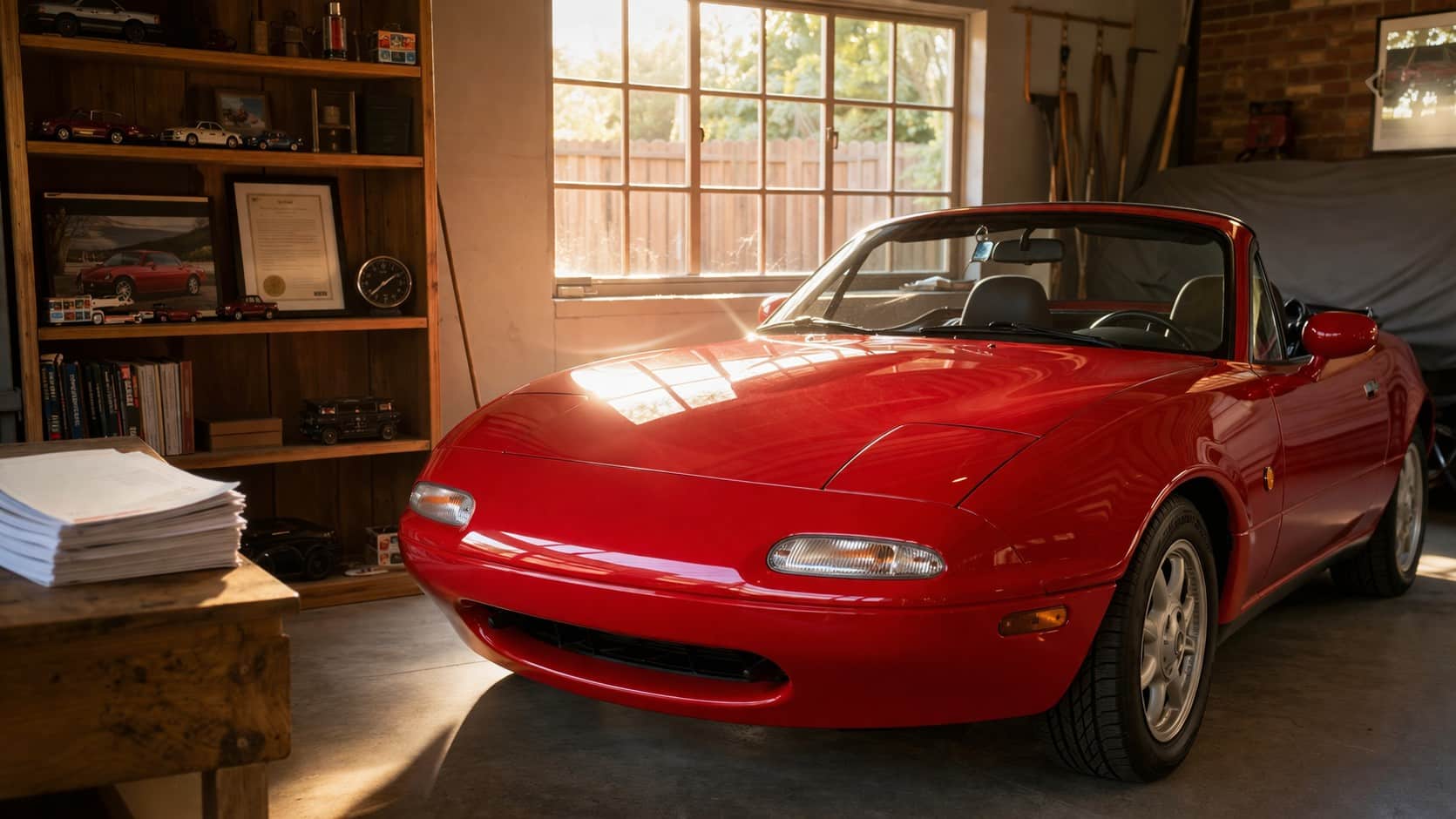
Where do NA Miatas for sale actually show up? Enthusiast auctions like Bring a Trailer and Cars and Bids set the top of the market. Club classifieds and the Miata.net forum often hold the honest, well-documented drivers. Local marketplaces hold everything else, including the rust buckets.
Stock or modified: the price reality
An unmodified NA with records sells faster and holds value better. A heavily modified car narrows the pool of buyers, and it tends to sit longer on the market.
A buyer torn between a “track-prepped” NA8 and a stock NA6 once asked MX5Global for a second opinion. The modified car was cheaper on paper. Returning it to stock would have cost more than the price gap. The stock car was ready to drive home that day.
Across the questions MX5Global receives about the MX-5, the real problem is rarely a lack of information. It is the gap between what the buyer imagines and what the market offers at their budget.
Want NA lightness with modern safety?
Airbags, modern crash structure, a much younger car.
The fourth generation is the closest modern echo of the original.
Buying an NA Miata in the US: title, inspection and paperwork
Paperwork first, then the state you live in
Four checks before money changes hands. After that, your state decides how strict life gets.
Meter shows relative strictness for an NA owner. Rules change: confirm with your state DMV.
An NA is old enough that the paperwork can hide as much as the paint. Rules also change sharply from one state to the next. Treat everything below as a starting point, then confirm with your state DMV.
Read the title before the car
Check the title first. A salvage, rebuilt or flood brand changes the value and sometimes the insurability. Match the VIN on the title to the car’s dash plate and door jamb. Then run a history report, knowing that records from the early 1990s are often thin.
Inspection and emissions depend on your state
There is no national inspection rule. Some states require yearly safety checks. Others dropped them. Emissions testing varies again, sometimes county by county.
California is the strictest example for NA owners. According to the California Smog Check Network (Which Cars Are Exempt From California Smog Check? The Official 2026 List, 2026), only gasoline vehicles from model year 1975 or older are permanently exempt. There is no rolling exemption. Every NA Miata therefore still needs a smog check there, so an intact, legal emissions setup matters when you buy.
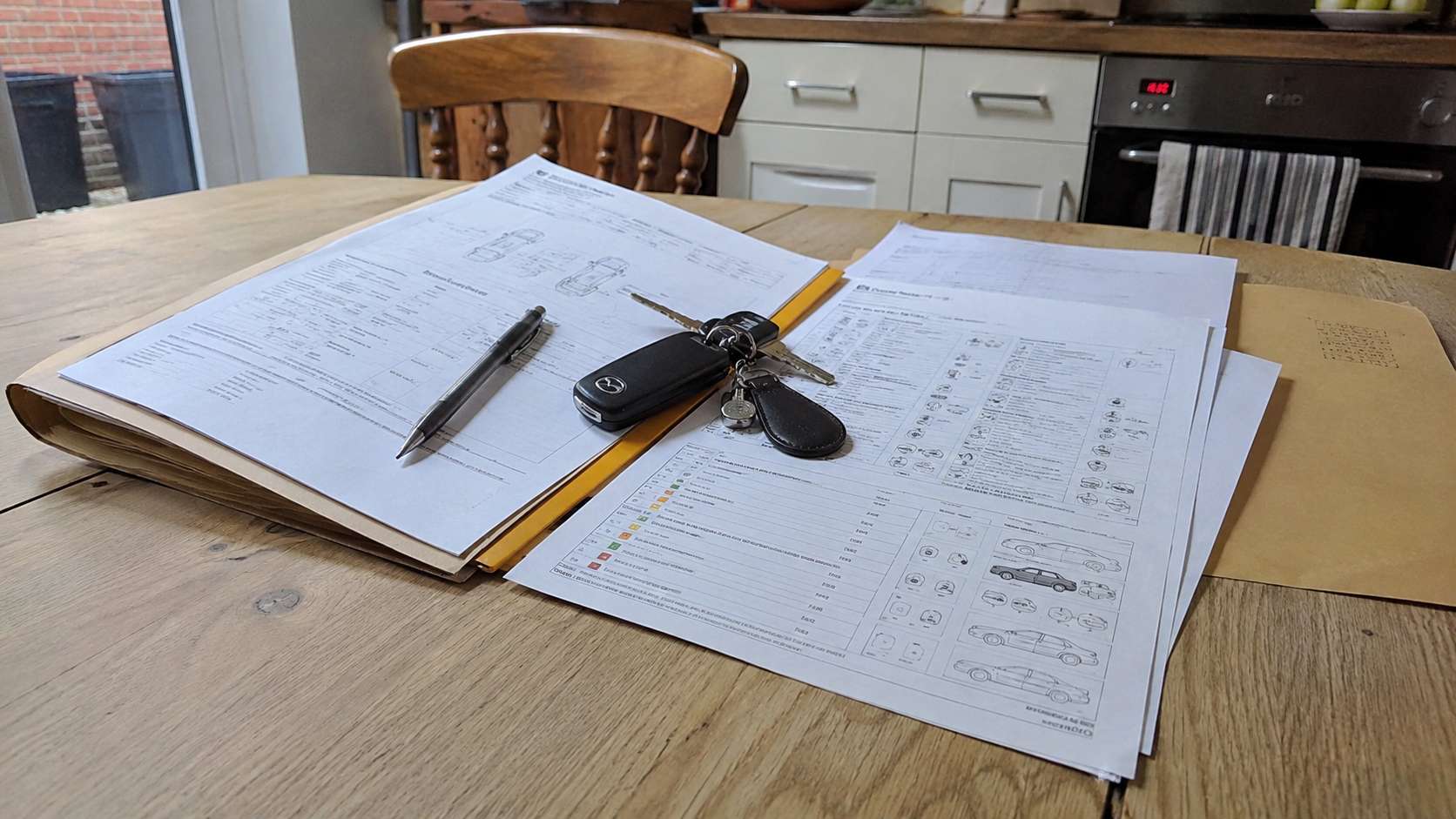
Contrast that with Pennsylvania, which still runs annual safety inspections, or Florida, which has no routine inspection for private cars. Texas ended routine safety inspections for most passenger cars in 2025, while some counties still test emissions. A missing catalytic converter might be a shrug in one state and a failed registration in another.
Classic plates and classic insurance
Many states offer antique or historic plates for cars past a certain age, often 25 years. Those plates usually come with limits on use or mileage. Read them closely before you give up daily driving rights.
Collector insurance with an agreed value is common for NAs now, from insurers like Hagerty. It usually requires a separate daily vehicle and secure storage. It rarely suits a car you plan to commute in.
The Eunos Roadster option
Japan sold the NA as the Eunos Roadster. Every one of them is now past the federal 25-year import threshold. Imports can be clean, rust-light cars, but they are right-hand drive and titling adds steps. Some states make that easier than others.
Living with an NA: parts, maintenance and daily use
The short service list that keeps an NA alive
One big job on a long cycle, a handful of small ones every season.
This is where the NA shines. Parts are cheap, the engine bay is roomy, and a huge community has documented nearly every repair.
Parts supply is better than the age suggests
In 2019, Mazda North American Operations launched a first-gen restoration parts program. It listed more than 1,100 new and legacy parts, from a fabric top to Enkei-built reproduction wheels. Details are in Mazda USA’s announcement. The aftermarket covers the rest. Flyin’ Miata, Good-Win Racing and 949 Racing all build parts specifically for this chassis.
The maintenance that actually matters
The timing belt is the big one. The 60,000-mile interval is widely followed, and the water pump often gets done at the same time. On 1990 and early 1991 cars, give that job to a shop that knows the crank issue.
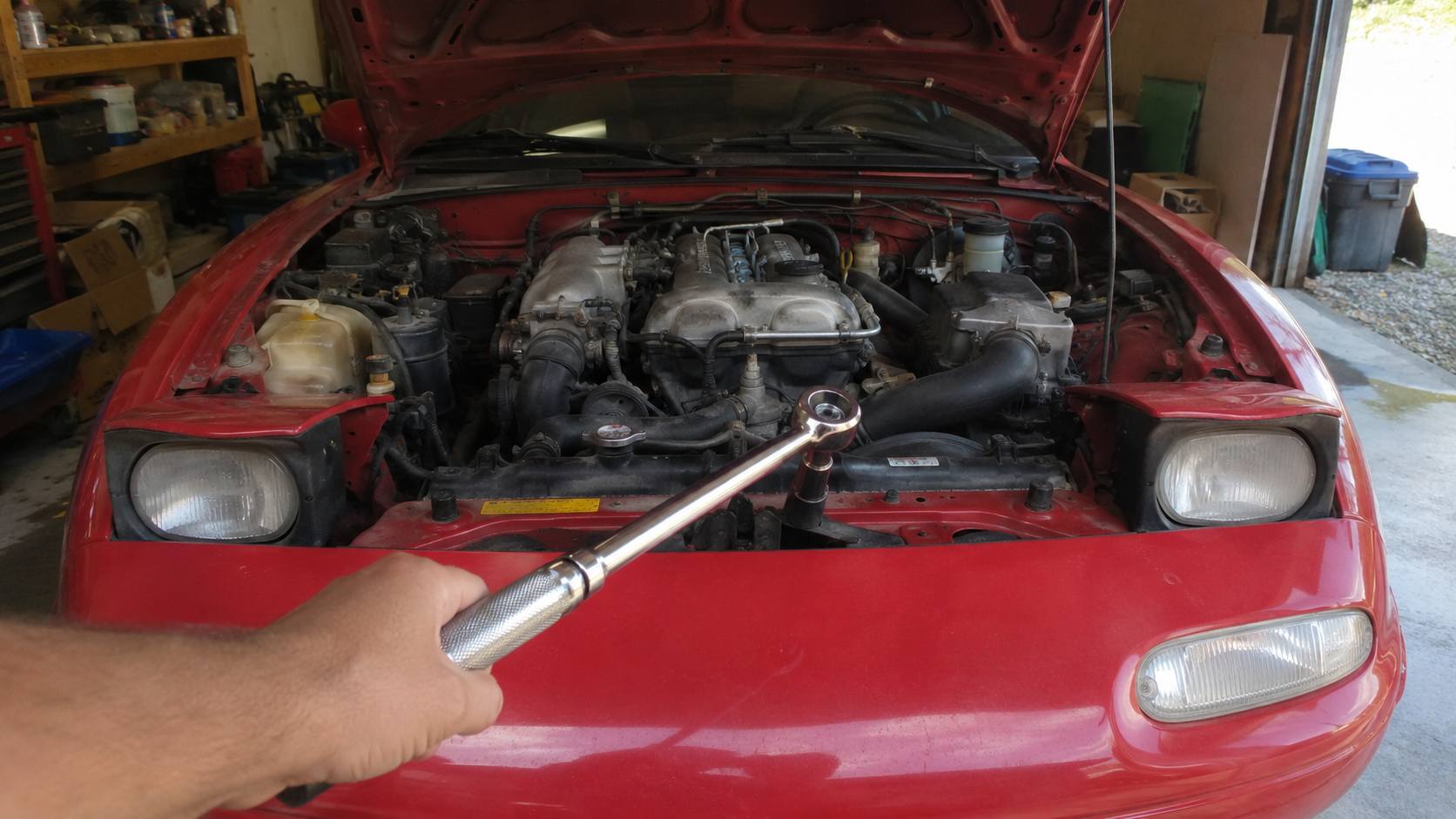
Beyond that, the list is short: fresh oil, clean coolant, a healthy radiator, clear drains and a top that seals. Most owners do these jobs at home with basic tools.
Can you daily an NA Miata?
Yes, with honest expectations. It has no modern crash structure, the cabin is noisy at highway speeds, and the trunk is small. For errands and fun commutes in a mild climate, it is a joy.
Need more room, more refinement and a folding hardtop option? The third generation is worth a look. Our NC Miata buyer’s guide explains why that car deserves more respect than it gets.
Three NA Miata buying mistakes that cost real money
Three mistakes, and what each one costs later
The cheapest fix is always the one you make before signing.
Mistake 1
Shopping by spec, not by body
An engine or package can be upgraded later. Structural rust cannot be negotiated away.
Mistake 2
Trusting shiny paint
Fresh paint is a question. A flashlight and a magnet answer it.
Mistake 3
Mods without receipts
Unknown parts can hide problems and fail an inspection. No receipts, no premium.
These errors repeat across listings, forums and buyer questions. None of them is about horsepower.
Mistake 1: shopping by spec instead of by body
Buyers fixate on 1.8 versus 1.6, or on an R Package badge. Then they overlook soft rockers. A spec is cheap to upgrade later. Structural rust is not.
Mistake 2: trusting shiny paint
Fresh paint on a 35-year-old roadster is a question, not an answer. Ask when and why it was painted.
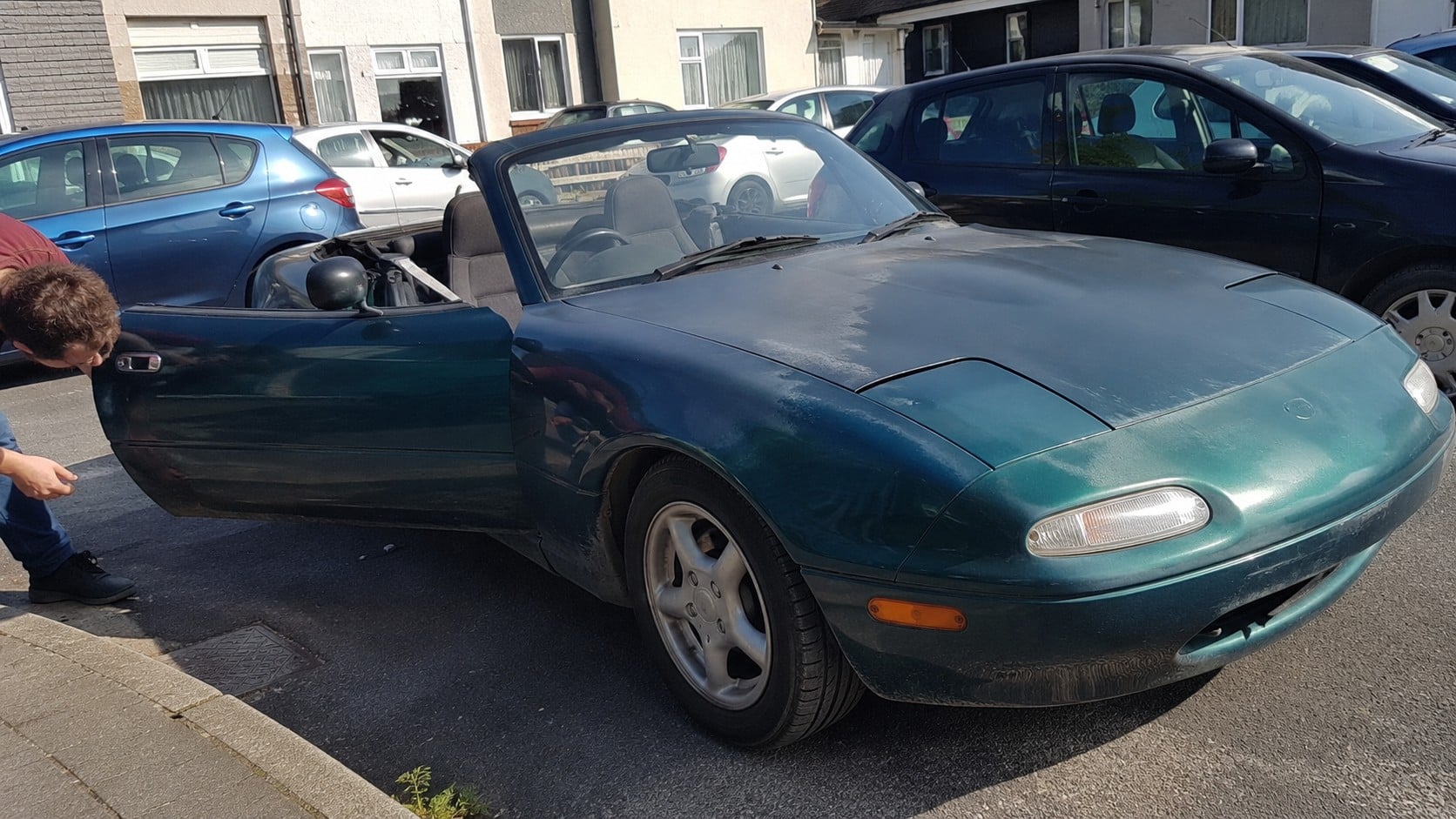
Then put a flashlight and a magnet on the rockers and rear fender lips.
Mistake 3: buying modifications without receipts
A modified car without invoices is a guessing game. Unknown coilovers, a mystery exhaust or a swapped engine can hide problems, and some can fail your state’s inspection. No receipts, no premium.
Buy the body, not the badge
Find your NA
Every road starts at the same gate: sound rockers and clear drains.
The NA Miata rewards patience more than any other generation. The right car is out there. It is rarely the cheapest listing, and rarely the one with the loudest story.
Start with rust-free rockers and clear drains. Then check the crank on early cars, the radiator, the top and the paperwork. Pick your engine and options last. That order saves more money than any negotiation trick.
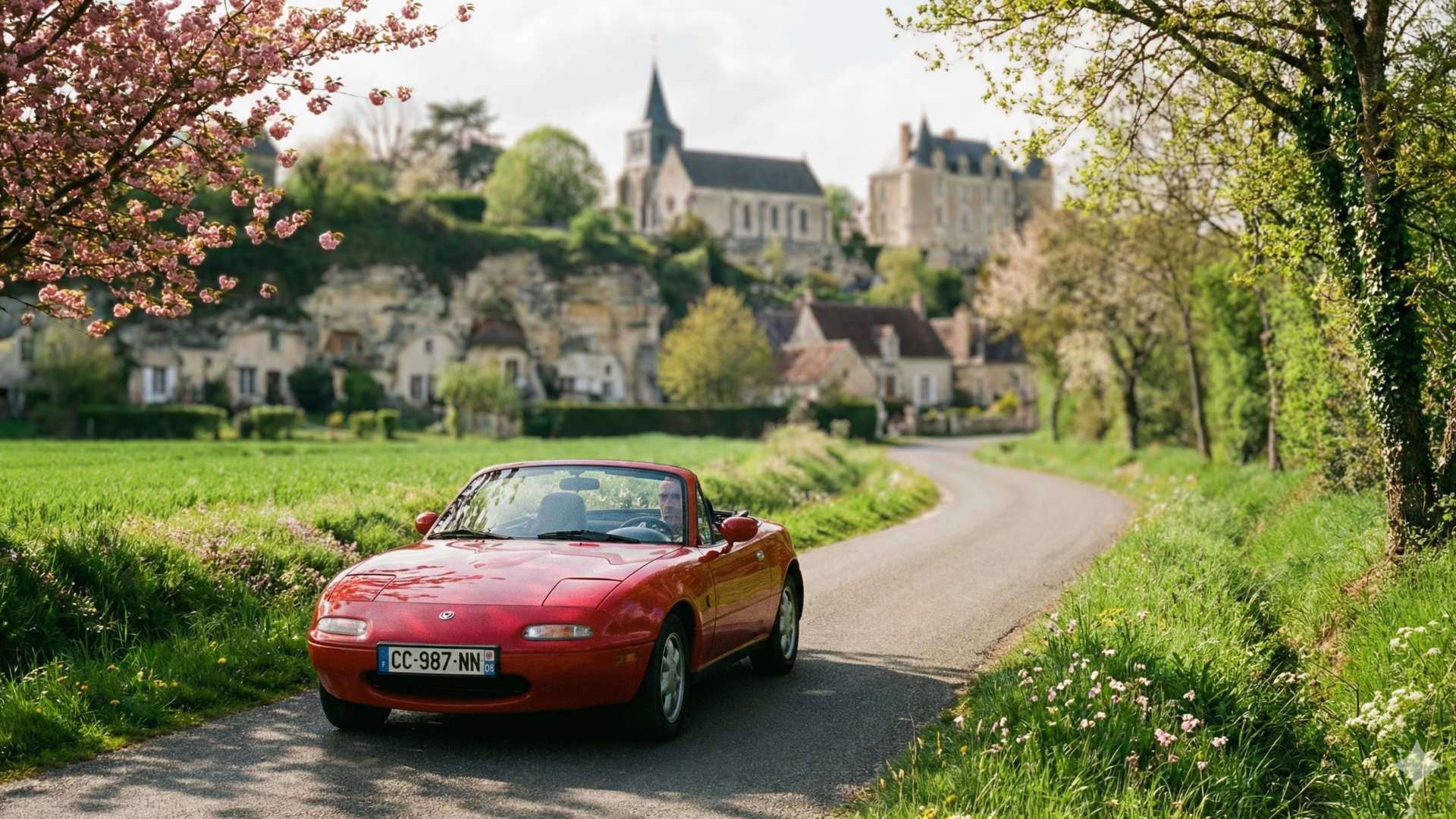
And if you are still unsure, ask yourself one question. Do you want a car that gets you there, or one that makes you smile every mile? The NA has answered that since 1990.
Your most common questions about the NA Miata
Is an automatic NA Miata worth buying?
Only if you cannot drive a manual. The four-speed automatic, offered from 1991, dulls the car’s biggest strength. That is the link between your right foot and the rear wheels. It also rules out the factory limited-slip. The market agrees, and a manual NA Miata is far easier to resell. If an automatic is truly your only option, price it accordingly and budget for a fluid service.
Will a tall driver fit in an NA?
It depends more on torso length than on height. Tall drivers often sit with their head above the windshield frame. With the top up, the fabric can brush their hair. Sit in the car before you travel to see it. Aftermarket low-mount seats are the classic fix. They buy real headroom without touching the car’s character.
NA or NB Miata: which should I choose?
Choose the NA for pop-up headlights, the lightest weight and the purest feel. Choose the NB for more power, a glass rear window, a stiffer body and generally younger, cheaper-to-find cars. Both share much of the same hardware. If the NA’s styling does not make you smile, the NB Miata is often the smarter money.
Is a factory hardtop worth paying extra for?
For winter driving, yes. A good factory hardtop makes the car quieter, warmer and more secure, and it protects the soft top from weather. Buying one separately can be expensive and requires paint matching. For a fair-weather weekend car, it is a pleasant bonus. If you want a roof that folds itself, the Miata RF is the modern answer.
Is a high-mileage NA Miata a bad idea?
Not by itself. The engines handle high mileage well when timing belts, oil and coolant were kept up. A high-mile car with documented maintenance is often the safer bet. A low-mile car that sat for years hides old fluids and dried seals. Records beat odometer readings every time. Ask for belt, clutch and coolant receipts before you ask for a discount.
Can an NA survive a salted winter?
It can, but it will pay for it. Salt accelerates the rocker rot the NA is already prone to. If you must drive through winter, rinse the underside often and keep the drains clear. Consider a cavity wax treatment inside the sills. Most owners in snowy states store the car from December to March instead.
Sources
- Hagerty , the base price of every Miata adjusted for inflation
- Hagerty , NA and NB Miata values and color analysis
- Hagerty , how to pick the right Miata generation
- OnAllCylinders by Summit Racing , NA Miata year-by-year changes
- Mazda USA , first-generation Miata restoration parts program
- Miata.net , technical guide to NA crankshafts
- Flyin’ Miata , identifying short nose and big nose cranks
- Grassroots Motorsports , NA rocker rust and drain discussion
- California Smog Check Network , smog check exemptions
- Wikipedia , Mazda MX-5 (NA) production and specifications

Alan Chevereau, founder of MX5Global
Alan is an independent SEO consultant and a Mazda MX-5 owner. He launched MX5Global on November 17, 2025, as an independent site dedicated to the Mazda MX-5 Miata. Every guide is built from verified sources, current market prices and published owner reports.
Leave a Reply