
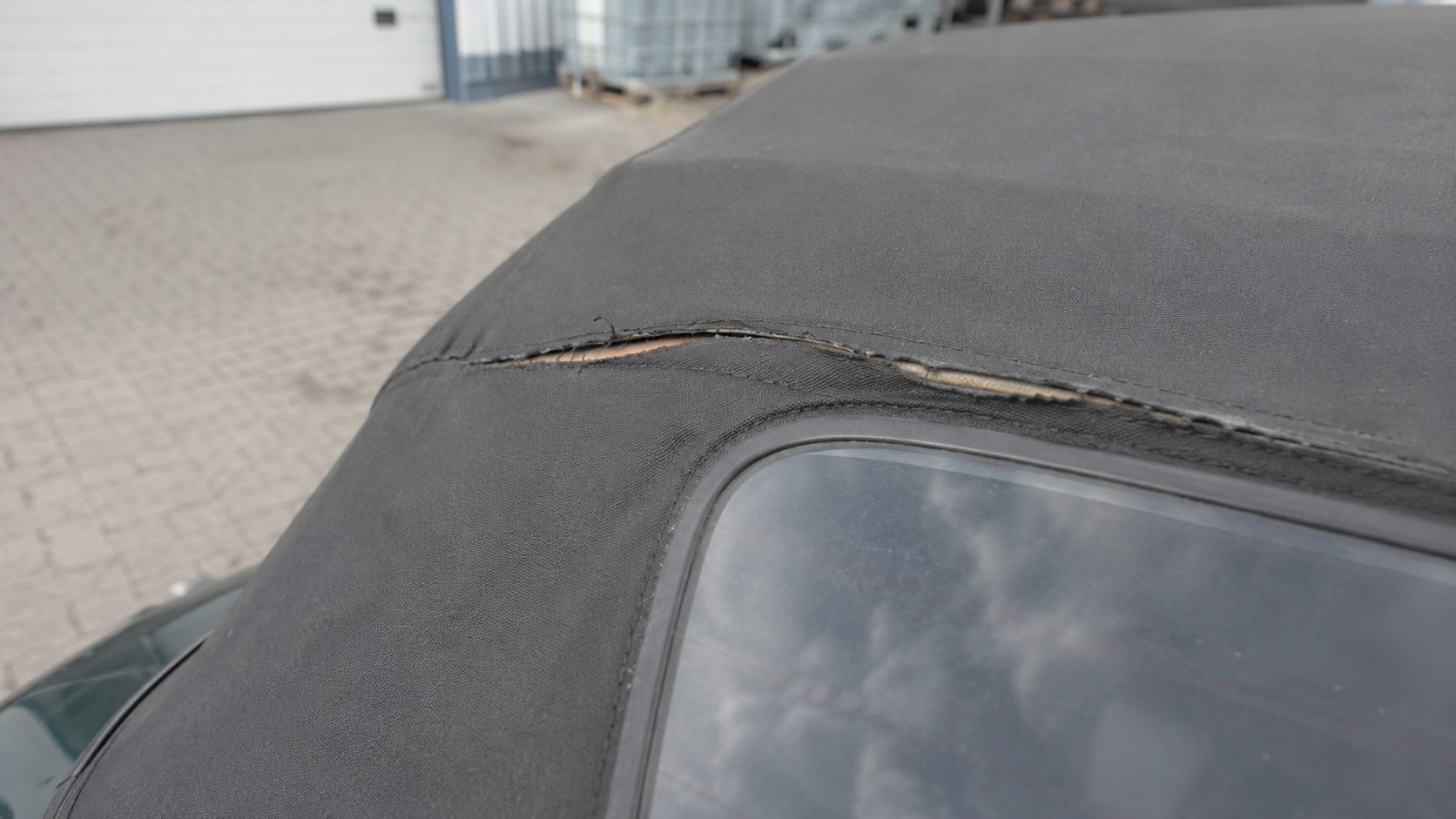
It rained overnight, and the carpet behind your seat is damp again. You fold the top back and see it. A split runs along the rear window seam. The vinyl feels stiff, almost brittle. Your NB Miata soft top is telling you its age.
Replacing it looks simple on paper. Then the replacement listings pile up. Factory style or Streamline, vinyl or cloth, zipper or no zipper. Some include a rain rail, some do not. Prices for tops that look identical are far apart. Pick wrong and you pay twice, or you keep the leak.
This guide covers one car: the 1999 to 2005 NB Miata. That is the second-generation Mazda MX-5, sold here as the Miata. You will know what Mazda fitted, what to order and where water really gets in. Start with the question most owners skip.
NB1 or NB2? Know your car before you order.Our NB2 Miata guide shows how to tell the two apart in 30 seconds.
Read the NB2 Miata guideIs Your NB Miata Soft Top Really Done?
Five-point top check
Where an NB top fails first
Run it on a dry, cool morning. Cold material shows its real condition.
- 1Fabric feelHard and crackling means plasticizers are gone
- 2White fold linesBroken fibers where the top creases
- 3Glass bondAny gap lets water track inside
- 4SeamsPale, loose thread fails next
- 5Frame wear pointsBows rub through the fabric first
A tired top and a dead top are not the same thing. Some faults end the top’s life. Others take ten minutes and a rag. Before you spend money, run five checks on a dry, cool morning, when worn material shows its real condition.
The five checks that decide it
- Fabric feel. Press the vinyl with your thumb. If it feels hard and crackles, the plasticizers have left it for good.
- White fold lines. Look where the top creases behind the seats. White lines that do not wipe off are broken fibers.
- Rear window. Check the bond all around the glass. Any gap between glass and fabric lets water track inside.
- Seams. Inspect the stitching above the rear window and along the deck seams. Pale, loose thread is the next thing to fail.
- Frame wear points. Top down, look where the fabric wraps the frame bows. Rubbing wears through there first.
Two or more of these signs mean a replacement is coming. One sign alone deserves a closer look before you order anything. A single loose seam can be restitched by a trim shop.
A plastic window on an NB tells a story
Mazda built the NB with a heated glass rear window in the soft top from the 1999 model year. Redline Auto Parts lists it among the headline changes over the NA. So a plastic window on an NB means the top was already replaced, usually with a budget part.
That matters in sunny states. A reader under a Hog Ring article on Miata tops put it in one line. Plastic windows turn yellow in the California sun. A hazed plastic window is a visibility problem, not just a cosmetic one.
Water on the carpet is the most common reason owners start shopping. It is also the least reliable sign of a dead top. We cover the real water path further down, and it often starts below the fabric.
What Mazda Fitted From the Factory, 1999 to 2005
1
replacement part covers all seven NB model years
What changed was material and color, mostly by trim. Swatches show factory originals.
It is easy to assume the 2001 facelift changed the top. It did not. The NB1 and NB2 share the same frame and the same replacement part. What changed over the years was the material and the color, and mostly by trim level.
Robbins Auto Top, which builds replacement Miata tops in the USA, lists the factory originals on its NB-style top page. Cabrio vinyl was used from 1990 to 2005. Stayfast cloth arrived only for 2003 to 2005.
Colors by year
On vinyl tops, black was available from start to finish. Tan, coded 1717, ran through 2002. A lighter Parchment replaced it for 2003 to 2005. The 1999 10th Anniversary Edition had its own dark blue vinyl top.

Cloth tops from 2003 to 2005 came in black, medium neutral and gray. Redline Auto Parts adds the context. For 2003, the LS trim moved to cloth while the base car kept vinyl.
The special editions worth checking
A few limited cars had their own tops. The 2000 Special Edition wore Parchment vinyl. The 2001 Special Edition had a tan cloth-look vinyl. The 2003 Special Edition used gray cloth, and the 2003 Shinsen a blue cloth top.
If you own one of these, the original color is part of the car’s identity. Replacing a blue 10th Anniversary top with black works, but a collector will notice. For a regular base or LS car, black is always a safe match.
Vinyl or Cloth: Which Top Fits How You Drive?
Your parking spot picks the material, not your taste.
Both keep rain out when fitted well. Noise, cold, care and looks decide the rest.
Tie-breaker: in Arizona or Florida, UV decides. In Ohio or Michigan, cold folds and winter moisture decide.
Both materials keep rain out when they are fitted well. The real differences are noise, cold-weather behavior, cleaning and looks. Your parking situation matters more than your taste.
What quality vinyl really is
Vinyl tops are not all the same weight or backing. According to Moss Miata (Robbins Factory Style Top listing, 2026), the vinyl is 38 oz Haartz Cabrio Grain. That matches the weight and pattern of original Miata tops. Moss adds that its 100% polyester backing avoids the shrinking and brittleness of cheaper cotton backing.
That 38 oz figure is a useful benchmark. A cheap top that does not state its material weight is usually hiding a thinner sheet. Vinyl wipes clean, sheds water on the surface and dries fast.
What cloth brings
Stayfast is a three-ply topping. The Hog Ring describes it as a square-weave facing, a rubber inner layer and a cotton backing. It looks deeper and matte, closer to what the 2003 to 2005 LS wore.
Cloth also tends to stay more supple in cool weather, so it creases less when folded. The trade-off is care. The weave holds dust and needs a protectant to keep water beading on the surface.
Match the material to your week
- Garaged weekend car: vinyl does the job and costs less. It rarely sees the sun long enough to age fast.
- Daily driver parked outside: cloth handles long UV exposure with a better look over time, if you treat it yearly.
- Highway commuter: cloth’s rubber middle layer tends to damp wind noise better at speed.
- Originality first: match the car’s trim. Vinyl for 1999 to 2002 and base cars, cloth for a 2003 to 2005 LS.
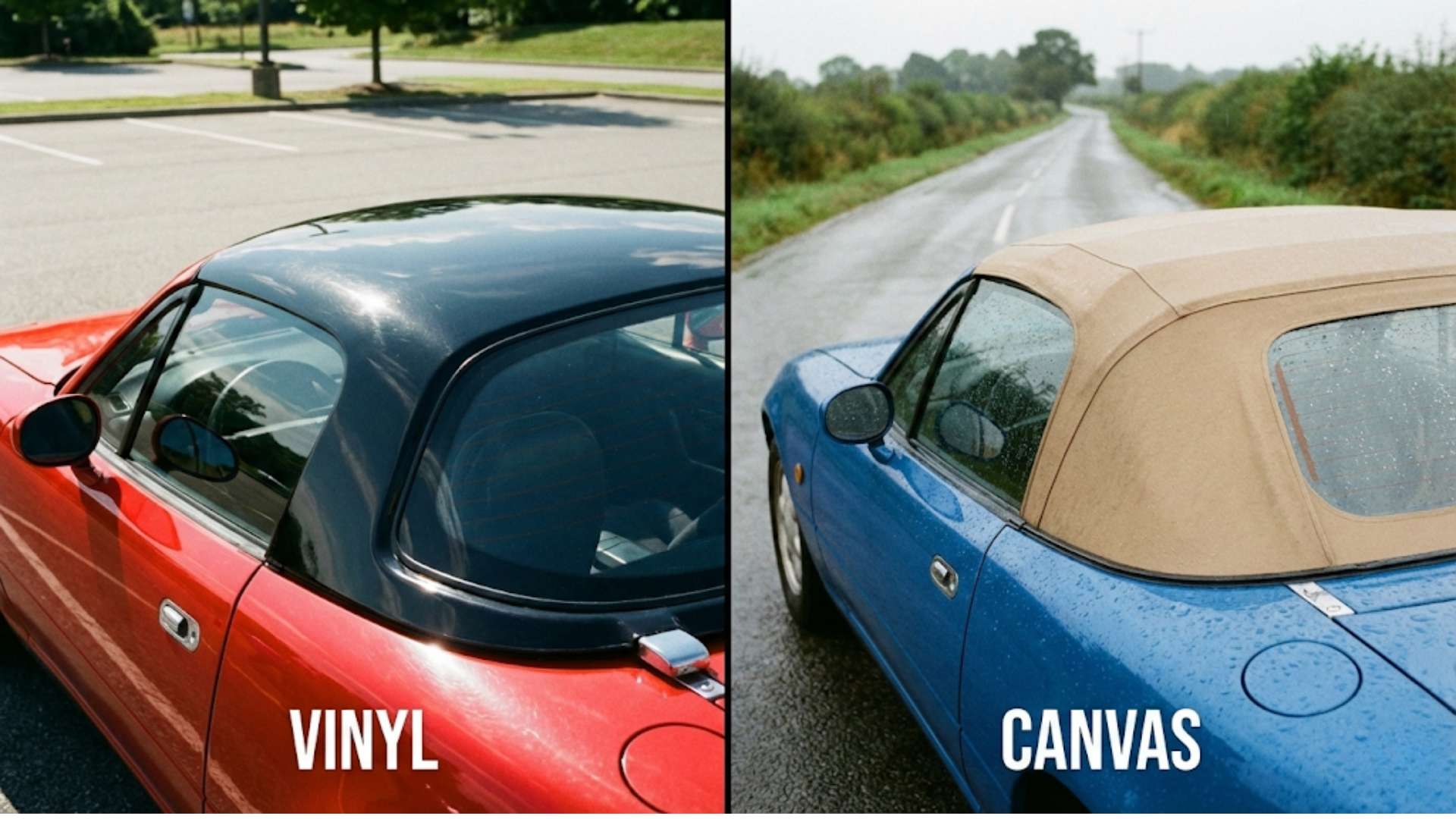
Resale follows the same logic. A vinyl top on a 2003 to 2005 LS tells an informed buyer the original cloth was replaced cheaply. On a 1999 base car, fresh black vinyl reads as correct and cared for.
Climate is the tie-breaker. In Arizona, Texas or Florida, UV is the enemy of any top. In Ohio or Michigan, cold folds and winter moisture do more damage than sun.
Factory, Streamline, Zipper, Rain Rail: Decoding the Listings
Anatomy of a listing
Four words change what arrives in the box
Fitment line: “1990 to 2005” is true, but keep your NB’s factory bow straps. Robbins supplies new ones for NA cars only.
Replacement listings use a vocabulary nobody explains. Four words change what arrives in the box: style, window, zipper and rain rail. Get them straight and most comparisons become simple.
Factory style or one-piece
A factory style top copies the original, including the deck seams running above the doors. It looks exactly like a stock NB.
One-piece designs drop those seams for a smoother profile. In its installation guidelines, Robbins notes that its 2916 to 2919 tops use 2006-on styling. That is the look of the NC Miata, yet these tops will not fit an NC. They are built for the 1990 to 2005 frame.
Heated glass or not
Your NB already has the defroster wiring. The connector sits on the trim panel behind the driver’s seat, according to Robbins. Choose a heated glass top, such as the Robbins 2960 or 2961, and your rear defroster keeps working. A non-heated glass top leaves that circuit unused.
Zipper or zipperless
On a glass-window top, the zipper is about airflow, not folding. You can drop the rear window with the top up on a hot day. Most owners never use it, and it adds cost and a seam that can leak.
Rain rail included, or not
The rain rail is the channel at the base of the top. It collects water and sends it to the drains. Old plastic rails crack with age. Leroy Engineering, an Ohio Miata shop, includes a new rain rail with every NA and NB top it sells.
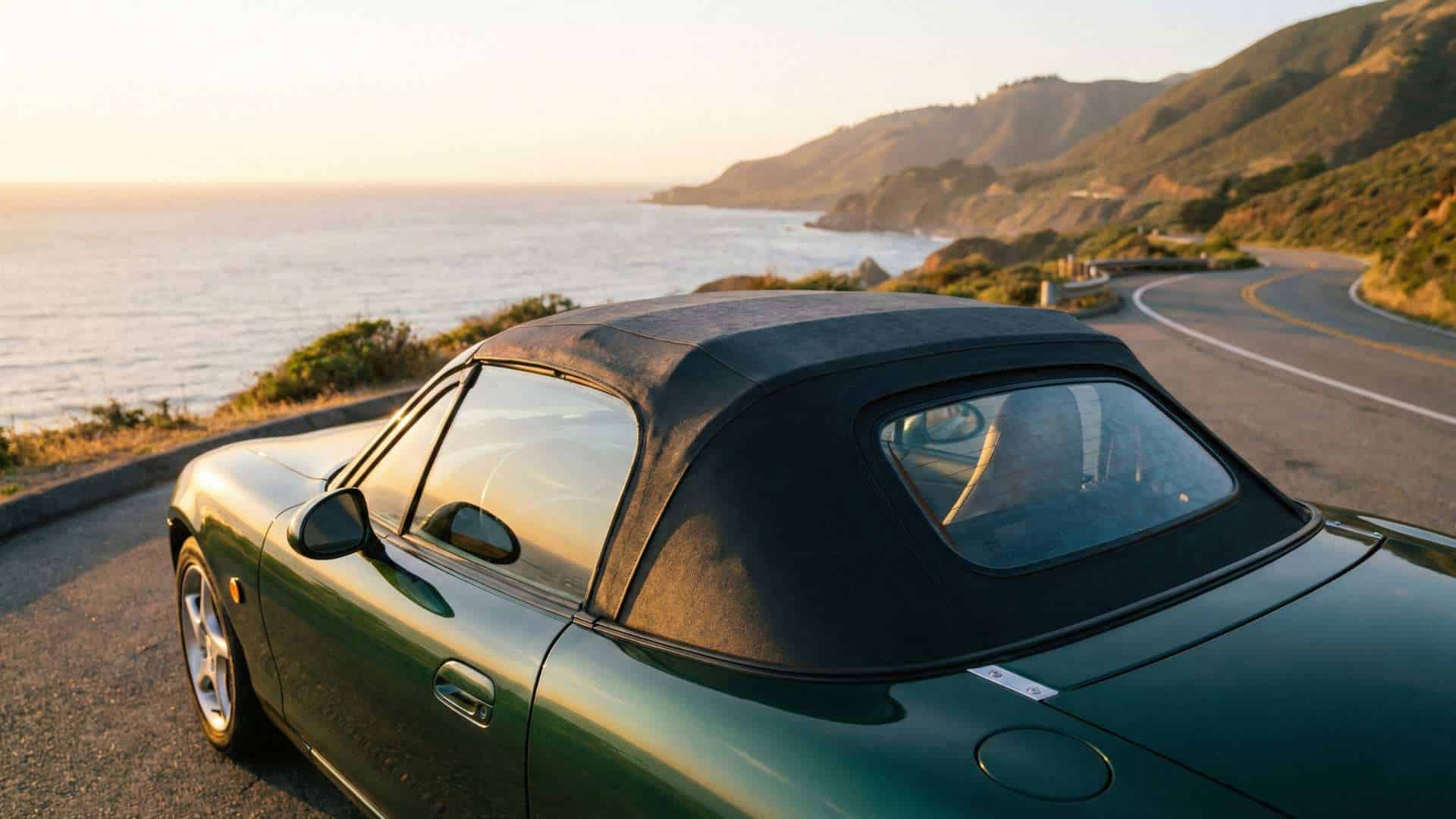
Buy a top with the rain rail already attached if you can. It saves one of the most frustrating install steps. It also removes a common leak source in one go.
The fitment line to read twice
Many listings say 1990 to 2005, which covers the NA and NB. That is true, with one detail. Robbins supplies new bow straps for 1990 to 1997 cars. It says 1999 to 2005 cars should reuse their factory straps. Do not cut yours off during removal.
Niche designs exist too. The Hog Ring lists a Robbins Panorama top with a rear window 22% larger than the factory one. It is a plastic window, so weigh visibility against the aging issue covered above.
What Does an NB Miata Soft Top Cost in 2026?
Anatomy of a price, Leroy Engineering, Robbins top
Where the money goes, from $805 to $1,334
$214.99budget plastic-window top, for scale
Prices below were checked in September 2026 on each retailer’s own product page. They cover the top only. Shipping, installation and small parts come on top.
| Retailer | Top | Window | Price |
|---|---|---|---|
| Good-Win Racing | Xtreme Series vinyl, no rain rail | 40-gauge plastic, no zipper | $214.99 |
| Moss Miata | Robbins Factory Style vinyl, zippered | Defroster glass | from $753.75 |
| Leroy Engineering | Robbins vinyl, no zipper, rain rail | Defroster glass | $805.10 |
| Leroy Engineering | Robbins vinyl, zipper, rain rail | Defroster glass | $1,103.90 |
| Robbins Auto Top | 2961 factory NB style, rain rail | Heated glass | from $1,110.95 |
| Leroy Engineering | Robbins cloth, no zipper, rain rail | Defroster glass | $1,114.69 |
| Leroy Engineering | Robbins cloth, zipper, rain rail | Defroster glass | $1,333.81 |
Buying direct from the maker is not always the cheapest route. According to Robbins Auto Top (Factory NB Style Top 2961 product page, 2026), this top lists at $1,307 MSRP. It is offered from $1,110.95 with a 15% discount, heated glass and rain rail included. Retailers such as Moss sell Robbins tops for less, so compare before you order.
When we lined these listings up for this guide, one detail stood out. At Leroy, the zipper alone adds $298.80 to a vinyl top. Moving from vinyl to cloth without a zipper adds $309.59. The option most owners never use costs almost as much as the material upgrade.
The $215 top, read honestly
Good-Win Racing is candid about its Xtreme Series top. It targets owners who usually leave the top down, or who are saving for other upgrades. It carries a three-year warranty, a plastic window and no rain rail.
That is a fair product for a track car or a summer toy. It is a poor match for a daily driver parked outside. You will also need a sound rain rail from your old top or a new one.
The costs that are not in the listing
Several parts often join the order once the old top is off. Plan for them before you compare top prices.
- Rain rail, if your top does not include one and the old rail is cracked.
- Side tension cables, which Robbins sells separately for 1999 to 2005 cars.
- Weatherstrips, if they are flattened, torn or hard.
- Trim shop labor, which varies by region. Ask for a written quote that names each part.
Lead time matters too. Leroy warns that Robbins does not stock every variation, so some tops take two to three weeks. Order before the season, not the week you plan a road trip.
DIY or Trim Shop: How the Install Really Goes
Install route, NB frame
Eight stops, three traps
where a good idea goes wrong
Robbins prints its advice at the top of its Miata instructions: professional installation is strongly advised. That is not a sales line. The job is not hard mechanically, but it rewards patience and punishes shortcuts.
One owner’s install, step by step
Adam at revlimiter.net documented a Robbins cloth install on his 2001 Miata, with 27 photos. His old vinyl top had lasted ten years, mostly parked outside, before tearing at the rear window corner.
He removed both seats first, four bolts each on the NB. He then took the frame off the car, three bolts per side, to reach the B-pillar pockets. The fabric fastens with four pop rivets per side, and the lower ones are hard to reach.
The final step was the hardest. Latching the new top took about half an hour in a garage near 120°F. He used zip ties, a helper and a bungee cord to pull it down gradually.
The sequence that works
- Clear the space. Remove the seats and roll back or remove the rear carpet.
- Strip the old top. Drill out the rivets and photograph every retainer before removal.
- Check the frame. Robbins asks you to file down burrs and rough welds on the ends of bows 2 and 3.
- Prepare the NB bows. Robbins specifies Velcro strips on the bow 3 ends for 1999 to 2005 cars.
- Rivet, then retain. Pop rivet the fabric first, then fit the B-pillar retainers.
- Glue and seal the front. Use contact cement on the front edge, then refit the header weatherseal.
- Mount and latch. Snug the rail nuts by hand, latch the top, then tighten with a 10mm socket.
- Reconnect and test. Plug in the defroster, then run a gentle hose test.
Three mistakes that look like good ideas
Tightening the rail before latching. It feels tidy, but it locks the fabric in the wrong place. Robbins says hand tight first, latch, then torque.
Fitting the B-pillar retainers early. Revlimiter found the retainer screws very hard to align before riveting. Once the rivets hold the fabric, the retainers zip into place.
Skipping the burr check. A sharp weld on a bow will rub a hole through new fabric. Ten minutes with a file protects a $1,000 top.
Choose DIY if you have a free weekend, a helper and a warm garage. Choose a trim shop if the car is your only transport. A shop also gives you someone to call if the top whistles at highway speed.
Why Does a New Top Still Leak?
The water path behind the seats
Four places the water escapes, ranked by frequency
- 1Clogged drain tube
- 2Cracked or pinched rain rail
- 3Worn or displaced weatherstrip
- 4Water from elsewhere
The one-cup test
1 cup per corner
Top down, pour into each rear corner of the rain rail. It should drain under the car within seconds.
Why it matters: trapped water feeds floor and sill rust. That repair costs far more than any top.
A new top that still lets water in is rarely a bad top. On an NB, water that gets past the fabric edge is caught by the rain rail. It then runs to drain tubes that route it through the body and out under the car.
Block that path anywhere and the water finds the cabin instead. Work through the causes in this order, from most to least common.
1. Clogged drains
This case shows up on the Car Talk community board. A caller blamed the Miata’s top for water on the floor. A reader answered bluntly: the top was not the problem, the drain plugs were, clogged with mud or pine needles.
Another owner made the same discovery during his install. Commenting on the revlimiter article, he wrote that his 2000 Miata’s drain holes were plugged. He cleared them with a wet-vac.
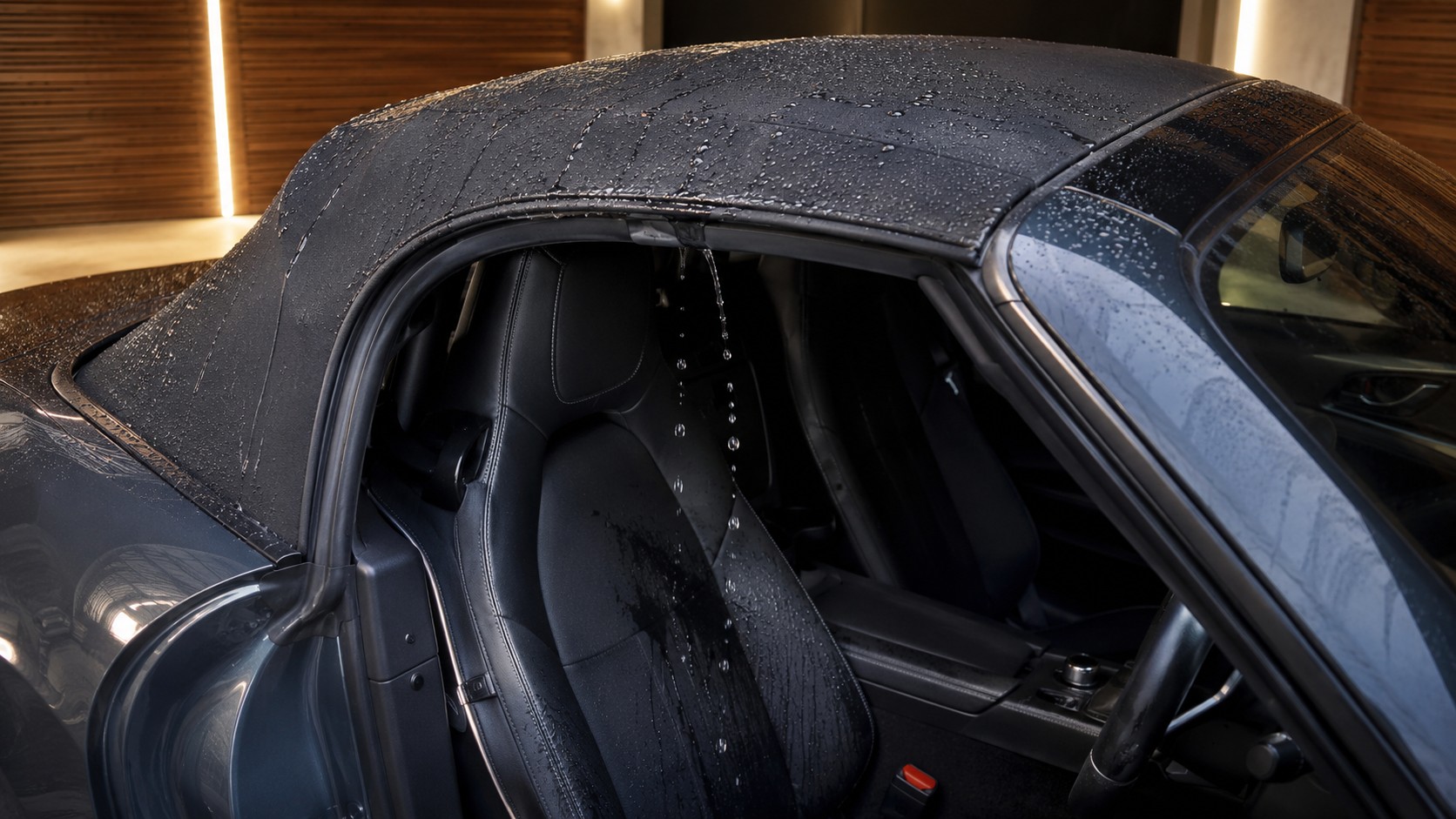
To test, pour a cup of water into each rear corner of the rain rail with the top down. It should drain under the car within seconds. A slow trickle means a partial clog.
2. A cracked or misplaced rain rail
A cracked rail sends water straight under the carpet behind the seats. A rail pinched during install does the same. If the drains flow but the rear carpet stays wet, pull the rail and inspect it in good light.
3. Worn or displaced weatherstrips
The seals along the header and the door windows age like the top. A seal that slipped from its channel after door panel work leaks at one precise spot. Look for drips always at the same corner.
4. Water that never touched the top
Some damp carpets have nothing to do with the roof. A clogged A/C drain or cowl area can send water along the passenger floor, even back behind the seat. Check it before you pull the top apart.
Leaks are more than an annoyance. Water that sits under NB carpets feeds floor and sill rust. On a Rust Belt car, that repair costs far more than any top.
Making a New Top Last in Sun Belt Heat and Rust Belt Winters
Sun Belt
UV is the enemy
Arizona, Texas, Florida, Southern California
- Park in shade whenever you can
- UV protectant made for your material
- Never a household cleaner
No raising or lowering below 41°F, per Mazda
Rust Belt
Cold and salt
Ohio, Michigan and the snowy north
- Cold folds crack vinyl
- Salty slush packs into drains
- Winter storage: top up and latched
A new top is the easy part. Keeping it supple for a decade depends on a few habits that cost almost nothing.
Temperature is the rule owners break most often. According to Mazda USA (2020 MX-5 Miata Owner’s Manual), never raise or lower the soft top below 41°F (5°C). Mazda states it will damage the top material. The manual is for the current generation, but cold vinyl behaves the same on a 20-year-old NB.
On a cold morning, let the cabin warm up before folding. Better still, leave the top up until the afternoon. The same manual lists four other rules that make sense on an NB too.
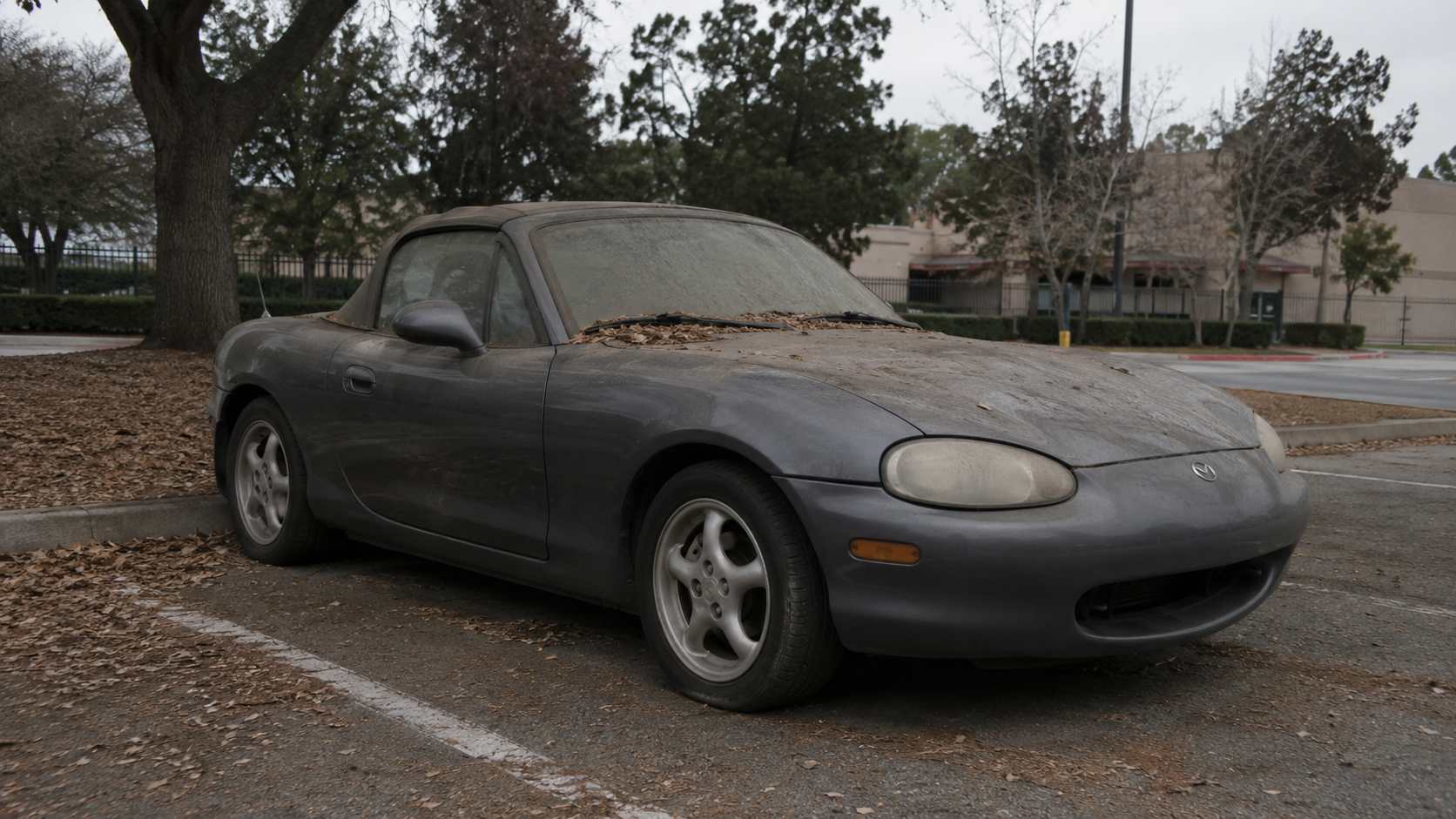
- Never fold it wet. Mazda warns a top that dries while folded will deteriorate and mold.
- Defroster off before opening. Heat from the rear defogger can damage the folded top.
- No automatic car washes. Mazda says they may damage the convertible top.
- Clear leaves and debris. Mazda asks ND owners to clean the drain filter yearly. On an NB, clear the drain tubes as often.
In the Sun Belt
UV is the main threat in Arizona, Texas, Florida and Southern California. Park in shade whenever you can. Use a UV protectant made for your material, vinyl or fabric, never a household cleaner.
In the Rust Belt
Winter brings two risks. Cold folds crack vinyl, and salty slush packs into the drains. If the car sleeps through winter, store it with the top up and latched, not folded for months.
Clear the drains every fall before the leaves drop, and again in spring. That single habit protects the top, the carpet and the floor pans in one move.
Soft Top or Hardtop for Your NB?
Decision grid
Rarely one or the other. Where does your NB sit?
Many top-down days, garaged winter
Soft top only
Spend on a quality top and rain rail.
Many top-down days, winter outside
Soft top plus a hardtop
The hardtop goes over the folded soft top for the cold months.
Few top-down days, garaged
Soft top and a breathable cover
A cheaper top can make sense here.
Few top-down days, outside
Hardtop most of the year
Keep the soft top healthy beneath it for summer.
Price check: a used OEM hardtop costs about as much as a quality new soft top.
A factory hardtop is the classic winter answer for an NB. It is quieter, more secure and immune to cold folds. It is also a second purchase, not a free fix.
The hardtop route has a real price. According to Worth Driving (Convertible vs. Hardtop Miata, 2025), a used OEM hardtop for an NA or NB can easily cost $1,000 to $2,000 or more. That range overlaps the price of a quality new soft top.
The good news is that the two can live together. A reader under an Autopian story explained that the factory hardtop is the same for NA and NB. It mounts over the folded soft top, with a few clips and a connector for the rear defroster.
That story itself shows the other side. Alanis King at The Autopian refitted her Miata’s soft top for a window tint test. The plan was to go back to the hardtop. She kept the soft top instead, and called herself a soft-top truther.
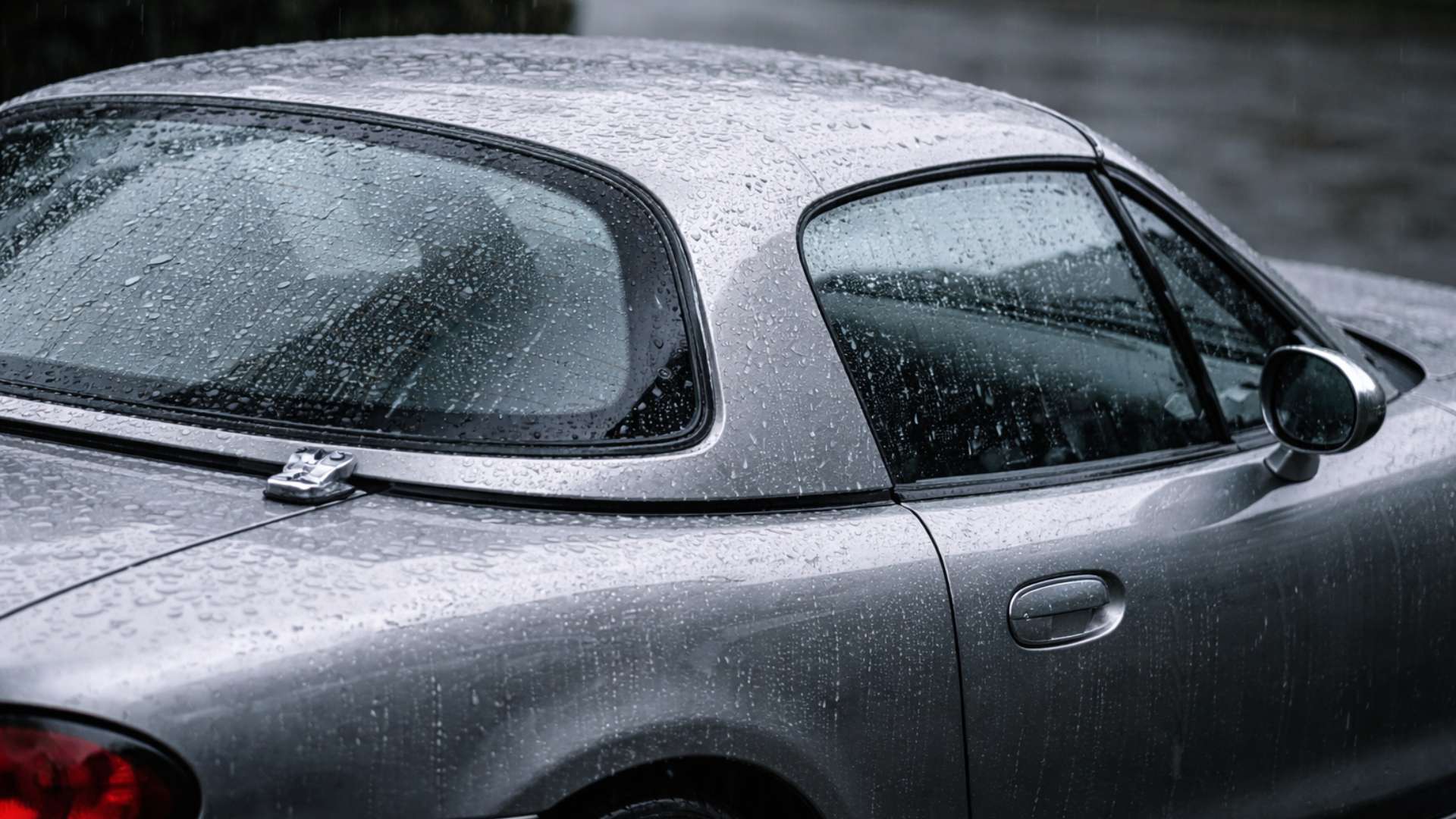
So the choice is rarely either one. For top-down driving, the soft top is the car. A hardtop earns its place if the NB lives outside through a northern winter.
If you want a roof that disappears at the touch of a button, that is a different car. Mazda’s own answer came much later with the Miata RF, built on the ND.
Order Once, Fit It Right, Keep the Drains Clear
Three moves, in this order
Your NB order sheet
- Material that matches your trim
- Heated glass window
- Rain rail in the box
- Factory bow straps kept
- Cables and seals checked
- Zipper, only if you want airflow
Fit it warm. Latch it patiently. Tighten last.
Most bad NB top jobs start with a rushed order. Check the drains before you blame the fabric. Confirm your trim, so you match the original material and color.
Then choose the details that matter: heated glass to keep your defroster, and a rain rail in the box. Skip the zipper unless you really want the airflow. That money is better spent on a trim shop or new cables.
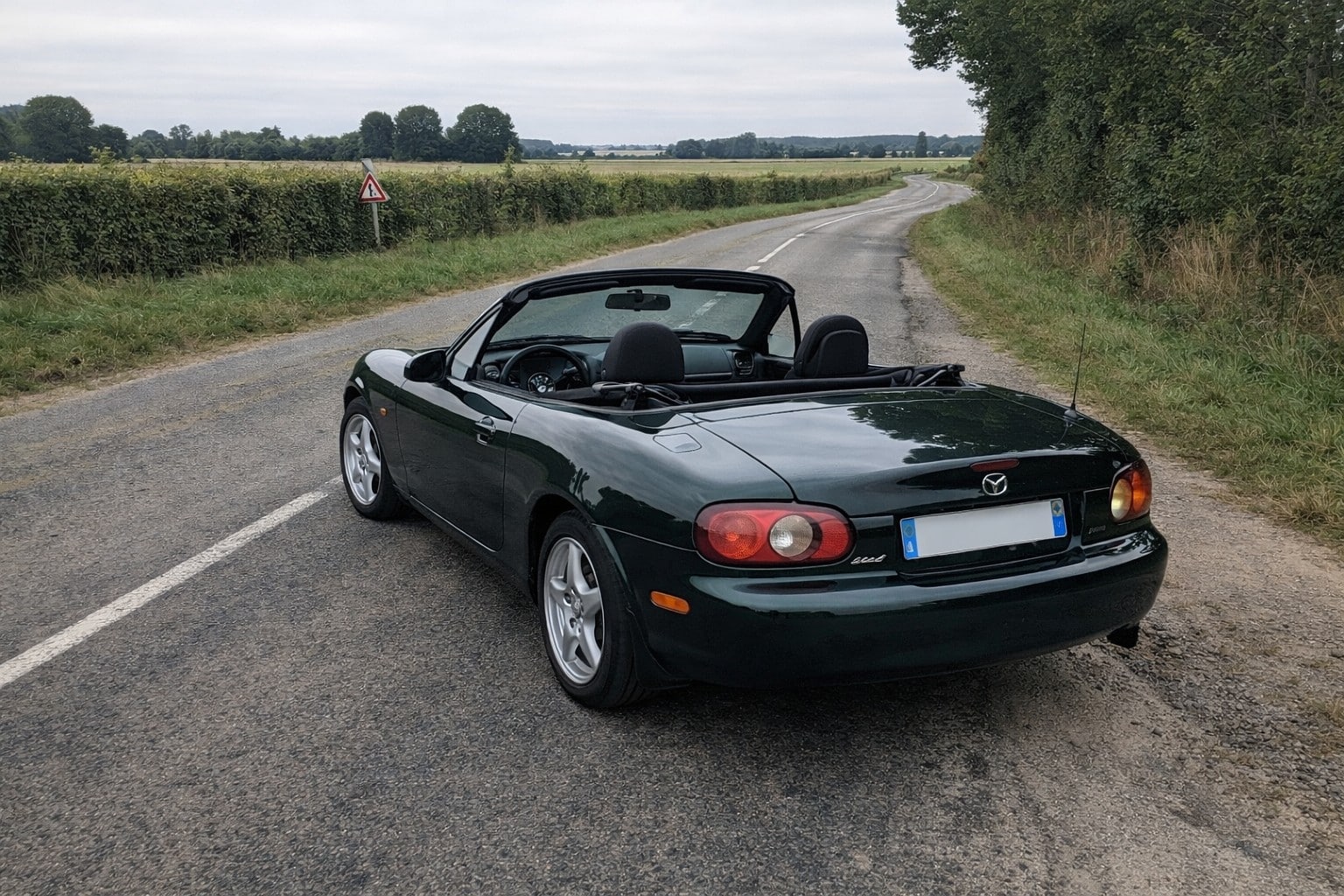
Fit it warm, latch it patiently and tighten last. Then give it the five-minute habits above every season. A good top on an NB should see many summers before you read a guide like this again.
Your Most Common Questions About the NB Miata Soft Top
Will an NA Miata top fit my NB?
Most quality replacements are sold for 1990 to 2005, so the frame fit is shared. The catch is the design. An NA-era top often has a plastic window and no heated glass, which wastes your NB’s defroster wiring. Look for a listing marked 1999 to 2005 style with heated glass, like the Robbins 2960 or 2961. Robbins says those also retrofit earlier NA cars.
Can I replace only the rear window?
Sometimes, but it is rarely the smart move on an old top. A trim shop can remove the glass panel and sew in a new one if the surrounding fabric is healthy. On a top with stiff vinyl or pale seams, the fabric will fail soon after. Paying labor on a dying top is money spent twice. Ask the shop to judge the fabric before quoting the window.
Should I replace the side tension cables too?
Replace them if they are frayed, rusted or stretched. The cables hold the side edges of the top tight against the door glass. A tired cable often shows up as a whistle at speed. Robbins sells cables specific to 1999 to 2005 cars. They cost little next to the top itself, and swapping them is easiest while the old fabric is off.
Is a used top from a salvage yard worth it?
Only as a stopgap. A used NB top is as old as yours, sometimes older, so its vinyl and seams are just as tired. What you really buy is the frame, the rivets and the hardware. That helps if your own frame is bent or corroded. For the fabric itself, expect a short reprieve, not a long-term fix.
Does a tan or Parchment top hurt resale?
Not when it matches the car. Tan was a factory vinyl color through 2002, and Parchment replaced it for 2003 to 2005. On those cars, a correct light top reads as original to an informed buyer. On a car that left the factory with black, a light top splits buyers and shows dirt faster. When in doubt, match the original color.
Can I fit the top with the frame installed?
Yes, many owners do. A reader under the revlimiter install fitted a Robbins top on his 2000 Miata that way. He left the frame in place and reported no real problems. The author removed his frame for a few hard-to-reach steps instead. Frame off gives better access. Frame on saves six bolts and a trip to the living room.
Sources
- Robbins Auto Top, factory NB style top 2961 with heated glass and rain rail
- Robbins Auto Top, installation guidelines for 1990 to 2005 Miata tops
- Moss Miata, Robbins factory style vinyl top and material specs
- Leroy Engineering, Robbins NA and NB soft tops by material and zipper
- Good-Win Racing, Xtreme Series budget convertible top
- Mazda USA, MX-5 Miata owner’s manual, convertible top precautions
- Redline Auto Parts, NB Miata buyer’s guide, year by year
- revlimiter.net, Robbins cloth top install on a 2001 Miata
- The Hog Ring, aftermarket Miata soft tops and Haartz materials
- Car Talk Community, leaking Miata convertible top thread
- Worth Driving, convertible vs hardtop Miata
- The Autopian, reinstalling a Miata soft top

Alan Chevereau, founder of MX5Global. MX5Global is an independent site dedicated to the Mazda MX-5 Miata, online since November 17, 2025. Alan is an independent SEO consultant and a Mazda MX-5 owner. Every guide is built from verified sources, current market prices and published owner reports.

Leave a Reply